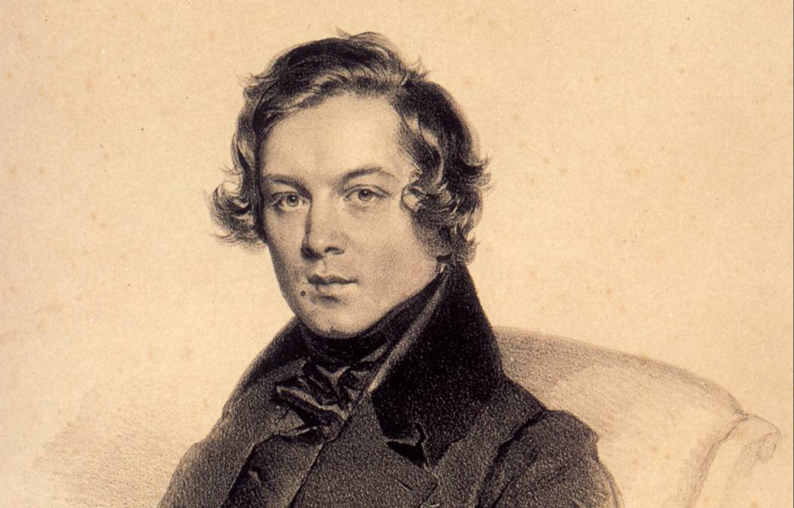
Schumann’s hidden masterpiece

In exactly one week, the Surrey Mozart Players will take the stage for our first concert of the season, featuring a work that has become very dear to me these last few weeks as I’ve come to know it well, the Violin Concerto in D minor of Robert Schumann.

As regular readers will know, the SMP is in the midst of a multi-season survey of the major works of Robert Schumann- we’ve recently done the concertos for piano and cello and the 2nd and 3rd Symphonies as well as some shorter works. Later this year we’re playing the Konzertstucke for Four Horns and the Fourth Symphony (final version). When this project first came to mind, I knew the violin concerto would have to be part of it, if only because, after a lifetime as a professional musician, I had yet to hear a live performance of it.

In fact, it was nearly lost to history completely thanks to the intrigues of Joseph Joachim, for whom it was written. Schumann wrote it in 1853 and Joachim read it with his orchestra that year, but had not learned it properly, and claimed his arm was tired from conducting (I’ll remember that one for my own use). He promised to give Schumann a better hearing, admitting “I did it such injustice,” but despite repeated promises to play it to Schumann at the asylum in Endenich, Schumann never heard it again. Joachim did occasionally read parts of it with colleagues, and played the piece through with Clara Schumann in 1855 in celebration of the Schumann’s 15th anniversary.

However, Brahms, Joachim and Clara eventually came to the conclusion that the Violin Concerto was a failure- Joachim went so far as to use phrases like “mental lassitude,” “bewildering passages,” “morbid brooding,” and “tiresome repetitions.” Together, the three decided the piece should never be published, and the manuscript was finally bequeathed by Joachim to the Prussian State Library with the stipulation that it not be published until 100 years after the composer’s death.

It was Joachim’s niece, Jelly d’Aranyi (for whom Bartok wrote both of his violin sonatas and Ravel wrote Tzigane) who first brought the lost concerto to the world’s attention. An avid spiritualist, she claimed Joachim had told her about it in a spiritual visitation. In the end, however, her Jewish heritage meant she could never give the first performance in Germany in 1937. Instead, the utilitarian Georg Kulenkampf premiered the piece, but with cuts and with the solo  part extensively re-written by Hindemith (whose contributions had to remain uncredited because he had since become labeled as a degenerate musician by the Nazi state).

The first performance of the score as Schumann wrote it was finally given a month later by Yehudi Menuhin , first in a violin and piano reduction at Carnegie Hall, then with the New York Philharmonic under another great violinist, Georges Enescu.

Since 1937, the work has had its champions, notably Joshua Bell and Gidon Kremer in recent years, but it remains a rarity. Even now, there is no full score available(UPDATE- as of 10.10.2009 Breitkopf has finally published a new Urtext edition of the work, which is wonderful news), only a pocket score. As I’ve gotten to know the piece, I’ve found that I completely disagree with Brahms, Clara and Joachim- it’s a wonderful, deeply moving piece, although I think that had Joachim come through on his promises of a premiere while Schumann was still well enough to hear it, he might have made a few small revisions.

Its continuing neglect may be the lingering effects of a painful birth. Perhaps the piece was a reminder of a painful time that the three friends wanted to forget- there is too much great music in it for them to have mistaken it so badly otherwise. Critics and commentators have always been tempted to outbursts of rare stupidity on the subject of Schumann in general, and his late music in particular, and it is very difficult to play for the soloist (Joachim obviously found it too challenging, and this was the man for whom Brahms wrote all his violin music).

On the other hand, I think it will always be music for a special state of mind- like the late music of Beethoven, long passages of it seem to already be part of another world, particularly the almost unbearably tender and fragile slow movement. Like the best late music of many composers, Schumann already seems to be living partly in the beyond.

Though I knew I wanted desperately to program the piece with the SMP, I was doubtful as to whether I could find a soloist- Josh and Kremer are out of our budget and few fiddle players have the time or technique to learn a work that so daunted Joachim and that they may never play again. Impressed by her performance of the Prokofiev G minor Concerto with us two years ago, I asked the young British violinist Alexandra Wood if she was interested in learning an impossibly hard piece she might never get to play again for a very modest fee. To my delight, she wrote back that she loved Schumann and would be delighted to take it on.

The first movement shares some of the rhapsodic and otherworldly qualities of the first movements of the Schumann Piano and Cello concertos, but the key of D minor (Schumann was very conscious of the historical associations of keys in the music of the past, and this movement has references to D minor works including the first movement of Beethoven 9 and the Bach Chaconne) gives the music an extra dimension of  power, existential dread and struggle. The brief slow movement, on the other hand, is intimate and fragile- one of the most beautiful in the repertoire. This is music that lives in a twilight realm of ephemeral visions, longings and hauntings. However, as in the other two concerti, Schumann leaves behind the sensitive and vulnerable side Eusebian side of his nature in the Finale, in which his confident, extrovert and optimistic Florestan persona comes to the fore in a jolly, virtuosic finale that pushes the soloist to the limits of the possible.

KW

Advice for the curious- the best resource on this work I know of is the marvelous essay by my drinking buddy Michael Steinberg in The Concerto, on which I have leaned heavily in writing this.

Here is a brief sample of the slow movement from Joshua Bell’s fine recording- buy it.


Share

Janacek in performance- only in New York

7:30 AM: Sunday morning and I’m up too freakin’ early- I’ve got a short window to meet my dear old friend, the marvelous horn player Nancy B, for breakfast. I’ve got to walk to Central Park South in time for a 9 AM meetup, then David Y can pick me up at 10:30 to head to Brooklyn for our concert.

9:00 Against all odds, I have found the restaurant on time, and Nancy is there.

10 AM: Breakfast is a delight, and with our stomach’s full and a line forming outside the restaurant, Nancy and I decide to vacate the table and have a walk around Central Park.

10:15 my phone rings. It’s David Y, who sounds collected but urgent-“Hey Ken, change of plan. My back just gave out on me while I was on the phone- I actually fell over. I think it’s better if I don’t drive. Can you come back here and drive us?”

Of course, I agreed, said a quick goodbye to Nancy and hopped in a cab back to 51st.

Continue reading

Share

Guest blog- David Yang on Janacek’s Intimate Letters

I thought David Yang’s script to accompany our performance of Janacek’s String Quartet no. 2, “Intimate Letters,” would make a great blog post and a wonderful primer on a rarely heard masterpiece, so with his permission I’ve edited and reformatted it to fit these pages. Enjoy.


A hero in his native Czechoslovakia, and one of the greatest and most original composers of the 20th C., Janacek had a hot-blooded disposition and a decided liking for the fairer sex. In 1917, after a particularly public and humiliating affair with the opera singer Gabriela Horvatova, his wife, Zdenka Janackova, took the 61-year old composer to court. The result of that settlement dictated that the couple would remain wedded on peaceful terms, continuing to keep house together but sleeping apart. It was at this time that Janacek met the 25-year old (and very married) Kamila Stosslova. Janacek fell instantly in love and she was to become the direct inspiration for many of his last works. Jancek’s wife, in her memoirs, wrote perhaps a somewhat objective description of her young rival….

“She gained my husband’s favor through her cheerfulness, laughter, temperament, Gypsy-like appearance, and buxom  body, perhaps also because she reminded him of Mrs. Horvatova, although she had none of that women’s demonic qualities or artfulness. She was natural, sometimes almost uninhibited. One couldn’t exactly say she won my husband over, for she didn’t try to… she herself was completely unimpressed by my husband’s fame, and also by his person; sometimes she laid into him quite sharply and at other times he seemed almost ridiculous in her eyes… I felt I’d no option when I saw how desperately Leos wanted this friendship. I said to myself that she could be a good support for me against Mrs. Horvatova.”

Janacek pursued Kamila relentlessly writing letter after letter, asking her to visit and inviting her to concerts yet often received no acknowledgement of his offers and, at best, sporadic replies. For years it was clear she did not take him seriously and he was often outraged by her perceived lack of gratitude and the flip manner of treating him. Yet her very elusiveness proved irresistible….. This letter is typical of Janacek’s mixture of desperation and resignation-

“How can one not want you when one loves you? But I know, don’t I, that I’ll never have you. Would I pluck that flower, that family of happiness of yours, would I make free with my respect for you, whom I honor like no other woman on earth? Could I look your children in the eye, your husband, your parents? Could I walk into your home? You know, we dream about paradise, about heaven and we never get to it. So I dream about you and I know that you are the unattainable sky. You are entire in my soul: so it’s enough for me to want you always.”

For Kamila’s part, she gradually did come to develop a deep affection for the older man although the exact nature of her feelings remain unclear to this day. The Second String Quartet, his last completed work, became an explicit chronicle of their relationship, in his own words, “both real and imagined.” It starts out with a masculine theme in the violins only to quickly come to a stunned stop in an eerie theme in the viola representing “the chilling mystery of an encounter with something new.” He wrote….

“Our life is going to be in [this piece]… I composed the first movement as my impression when I saw you for the first time….Kamila, it will be beautiful, strange, unrestrained, inspired, a composition beyond all…..Its my first composition that sprang directly from things remembered; this piece was written in fire.”

Click here to listen to the “Janacek” theme from the opening of the first movement.

The second movement depicts to the town where they met and shared their first kiss (which, according to Jancek’s diaries, occurred on 26 August, 1927. )

“Today I wrote in musical tones my sweetest desire. I struggle with it. It prevails. You are giving birth. What would be the destiny of that newborn son? Would it be ours?  Just as you are, laughing with tears in your eyes – that is how it sounds.”

Click to listen

A boisterous childlike theme half-way through the movement is followed by a tender, sad variation in the first violin.

Click to listen

Then the childlike theme reappears in the viola with the original “Janacek” theme from the first movement  in the violins as if the older man and young child were playing together.

Click to listen  

“I am now writing the third of the Love Letters. I want to make it particularly joyful and then dissolve it into a vision like your image. How could I not be overjoyed remembering the times of being with you when I felt as though the earth was trembling under my feet…. This will be the best [movement so far]… now  if only the last would turn out well, too. Writing this is like the worry I feel about you.”  

Click to listen  

There was always tension between Janacek and Kamila. Him desperate with longing for her, never knowing exactly where he stood, always trying to bring her closer; her keeping him forever at arms length but only at arms length and never further.  

The last movement represents Kamila’s peasant roots and the way she seemed always just beyond his grasp. Writing of the last movement he said…    

“[this] last one won’t finish with fear for my pretty little weasel, [rather] with great longing and fulfillment.”  

Click to listen  

Jancek was burning with impatience to send the work off to Kamila but wanted to hear it first to see if it had any merit. He wrote of the first performance on  June 27th, 1928.

 “You know, feelings on their own are sometimes so strong that the notes hide, run away. A great love – a weak composition. But I want [this] to be a great love – a great composition……I listened to their playing today [and ask myself] did I write that? Those cries of joy, but what a strange thing – also cries of terror after a lullaby. Exaltation, a warm declaration of love, imploring, untamed longing. Resolution, relentlessly to fight with theworld over you. Moaning, confiding, fearing….Standing in wonder before you at our first meeting…..Oh, it’s a work as if carved out of living flesh. I think that I won’t write a more profound or truer one.”  

At this time he also changed the title he gave it from “Love Letters” to “Intimate Letters” in order to keep the true program more private, saying “I won’t deliver my feelings to the tender mercies of fools”  After asking her to spend her summer holiday with him at his country villa in Hukvaldy, Kamila finally relented and traveled with her son, Otto and her husband, David (who soon left on business). On Monday, August 6, Otto got lost while they were all hiking and Janacek combed the forest looking for him pushing himself past exhaustion and getting soaked in a downpour.  The boy found his way back on his own but Janacek caught a cold which he tried to conceal from Kamila. Yet by Thursday he called the doctor who diagnosed the flu and the onset of pneumonia. The next day, as his health declined and his temperature hit 104, an x-ray revealed an inflamed lung and by Saturday he realized he was dying.  He became unconscious on Sunday morning and died peacefully on Sunday night, August 12th.  

During the visit to Hukvaldy, Kamila had brought with her a small diary, in which Janacek recorded his thoughts and observations. On August 8th, already feeling the effects of the excursion to the woods, wrote how happily the days were passing. On August 9th, the day the doctor was summoned, and he did not write in the album. But on August 10th he wrote in the album for the last time, recording his sweating during the night and his gratitude to Kamila.  

“And I kissed you.  

And you are sitting beside me and I am happy and at peace.

In such a way do the days pass for the angels.”  

Listen here.  

Citations and bibliography available on request.   Copyrighted material is reproduced here without profit for educational purposes only under Fair Use provisions of relevant copyright law, and will be removed on request of copyright owners.  

Share

Janaceking in the Big Apple

Saturday again offers only a short window of rehearsal, shortened by New York traffic to less than two hours. We try to work quickly though the problem spots we’d been unable to touch the day before in Philly, but we’re racing the clock- Yonah has another engagement later that afternoon. With time running out, we decide to run the piece. We run the first movement, which mostly goes well but which triggers a brief discussion, killing priceless minutes. After the 2nd movement, Yonah asks me the time- I look at my phone. He has to leave at four PM. The phone shows 4 PM exactly. I do a terrible thing, but one I hope he’ll forgive me for later- “three fifty-six,” I say “we should hurry up.”  Bless him, we finish the last two movements- evening I was telling the truth, he’d be leaving five minutes late, as it is, it’s ten.  However, in spite of the mad rush, we’re starting to sound like a string quartet- not a “real” quartet, but a quartet.

Our hours in New York fly by all too fast, and soon it is time to make our way to our first performance, at a house concert near Columbia University. Our audience is mostly neuro-scientists.David Yang and I make our way there on the hottest subway train I’ve every boarded, and meet Yonah and David Ehrlich. Happily, Yonah has made it to and from his gig. Our hosts are legends for their hospitality and love of music, and the house is welcoming and cluttered with the happy reminders of a vibrant life of the mind- books, programs and music are everywhere. In the chaotic moments before the friends and neighbors arrive, we’re trying to fix as many intonation issues as we can.

Tonight we’re just doing the Janacek, with some narration and introduction written by David Yang. The narration feels a little stilted in a living room- none of us can quite transition into a stage voice with the audience only a few feet away, but I feel like the structure of what David has written is very strong in spite of our inability to bring it off.

The performance, however, is pretty good- Janecek’s four movements and 80 tempos are starting to feel like a single utterance, and our audience seems blown away by the piece over wine and nibbles afterwards.

After letting Janacek kick our collective butts for a few days, we’re all feeling pretty good. Sunday, we’ll meet for a 2 hour dress rehearsal at the hall, have a leisurely lunch then perform. With a nice chunk of rehearsal time awaiting us, we’re feeling confident and excited- after all, what can go wrong?

Share

Janaceking on the East Coast

I’m spending my week in Philadelphia and New York to prepare and perform a very special piece of music I’ve been wanting to learn for many years, Janacek’s 2nd String Quartet.

My colleagues in this endeavor are violinists David Ehrlich and Yonah Zur, and violist David Yang. Also on the program are two short string trio selections- the Trio Satz in B-flat of Schubert and a rather perplexing work of Mozart’s a Prelude and Fugue in D minor, K 404.

Our week began with the two trios, programmed because Yonah’s schedule didn’t allow him to be present for the whole week. We read the Schubert first, an early but startlingly mature and original piece. I’m intrigued by David Ehrlich’s way with this music- he has tremendous control of timing and rhetoric, and the piece already feels like something, in spite of its surface simplicity, on first encounter.

The Mozart is more elusive. I’m literally sight-reading, having only gotten the music on my arrival. The prelude is a very Mozartian thing, in a gracefully lilting 6/8, but the fugue is something else entirely- it’s Bach! It’s from the Well Tempered Clavier, Book 1 No. 8, transcribed and transposed (from the original E-flat minor to the more user-friendly D-minor) by Mozart. We read both movements and set to work first on the Fugue. I know the piece to listen to, but what a thrill it is to play, especially as I’d never expected to play it. We quickly dispensed with the vaguaries of a lousy edition- a mixture of Mozart’s transcriptions with lots of very Romanticized markings of a long-deceased editor.

The political-correcticization of early music has made us all a bit careful about when and with whom we perform Baroque music. My inclination in this music is to play it with little or no vibrato, lots of mezza di voci and to feel it in “2,” (Roger Norrington would love my Bach) but I’ve just met one of my colleagues and don’t want to start an argument. To my delight, though, we find ourselves quickly finding common ground and agreement. In some ways it gets more challenging when we return from Mozart’s transcription of Bach’s Fugue to Mozart’s own Prelude, an attractive piece, but one that feels rather slight next to Bach at his deepest and most mature.

Central Philly is mostly new to me- about 10 years ago I had gone into town to catch a Philadelphia Orchestra concert, but didn’t get any sense of the city. What a town! David Yang takes us around to the amazing Italian market- blocks and blocks of butchers, green grocers and cheese merchants. There are dozens of lovely restaurants and a fab coffee house (Charterhouse Coffee). Even better, there’s a true neighborhood feel- David’s neighbors all seem to know, like and look out for each other.

Yonah’s arrival meant we could finally get cracking on the Janacek. After a short read through on Wednesday night, we take all day Thursday to get to grips with the piece. It is nothing short of ferocious and all of us are learning it for the first time. There are near constant changes of either meter or tempo, and it’s incredibly hard for intonation because of the way Janecek voices chords, emphasizing perfect intervals and wide spacings. Janecek also pushes us all to our technical limits with us extremes of range and fondness for lightning fast ostinati.

We ended our marathon day on Thursday by running the quartet- it was both humbling and encouraging. For a group that had only been together 24 hours, it was starting to sound like something, but there were huge challenges ahead. After the long hours on Thursday, Friday offered a different problem- how to squeeze everything we needed to do into less than two hours in the morning before boarding the trains for New York.

Having finished the previous day with a run-through, each of us comes in prepared with a list of spots we felt had been problematic. Our work to date having been tested in a run-through, we’re able to make rapid progress just focusing on the things that have gone wrong the night before. However, the clock soon runs out on us, and it’s time to pile everyone into a tiny vehicle and make for the train station and New York City.

How funny that the previous week I should be on the island of Procida, setting of the movie Il Postino and a place almost completely untouched by time and trends and this week I should be working in the Big Apple, land of the 10 second trend and the 5 second fad….

Share

KCYO 08- Gale of Life

In spite of the significant technical challenges for all the players in Philip Sawyers Gale of Life Overture, rehearsals moved along at a quick pace. The main reason for our smooth progress was the immense care Philip had obviously taken in making his writing as idiomatic and his notation as clear as possible. Most Vftp readers have already been there, but you may wish to check out my “tips for composers” which attempts to explain what I consider common sense best practice for getting one’s music played well again and again.

There’s quite a lot of bitonal writing, especially using choirs- for instance the horns often play a chord a step above or below the trumpets and trombones. In addition to the bitonal writing, there’s a lot of quartal and quintal harmony, all of which is fun to work on and satisfying when it starts to ring.

One of the highlights of the whole week for me was the few minutes we spent tuning a passage in parallel thirds in the violins. Going diad by diad, it was so fascinating how this most familiar and friendly of intervals seemed to become more and more alien and exotic as the passage went on, especially once the intonation started to click. I think we all heard the piece with different ears after that. Every once in a while, you’ll have a discovery like that in a rehearsal which is so revelatory that you’re almost tempted to repeat it for the audience before the performance. I mean, why not “ladies and gentlemen, we were rehearsing this the other day, and it sounded so cool by itself we thought we had to share it with you!”

Gale of Life is a bit of a departure for Philip- an intentionally direct concert opener. The piece came about after the premiere of this First Symphony- some musicians were commenting after the concert how the virtuosic scherzo would make a good concert opener on its own. Present that night was David Allan Miller, conductor of the Albany Symphony, who was taken enough with the idea to commission Gale of Life.

According to the composer, the piece is partly an homage to Berlioz, who was an all-time master of the burn-burner overture.

Philip Sawyers and Kenneth  Woods at the UK Premiere of Gale of Life

In the interests of getting more of this music known, I’m happy to make available our performance with KCYO the other night. Considering that the original commission stipulated “a virtuoso piece to make the best American brass players break a sweat,” I’m quite proud of how well the orchestra played. We’re sorry the sound quality isn’t first rate- this was recording on a simple mini-disc rig. The next performance is December 4th at the Eugene Symphony, under David Lockington. Click here to listen (about 10 minutes)

Share

BBC Radio 3 puts the car stereo through its paces

It’s hard to accept that the Proms season is nearly over, and that this will be the first year in a long time that I haven’t been to a concert at the Albert Hall in person. I’m doubly sad about that because it seems like it’s been an awfully good year at the Proms.

As I made my way slowly, slowly back from rehearsal on Sunday through road closure after road closure, I felt like I was experiencing everything I don’t like about Britain- terrible traffic, white vans and a deeply sadistic approach to the general public from the wise heads who run the nation’s crumbling transit system.

However, as I turned off of the closed M6 Motorway for several hours of detours and re-routing (including the closure of the A 49, the only real alternative to the M6, I was reminded of what I love about this country when I turned on Radio 3, which can still astound and amaze. Within seconds I recognized the first act of Messiaen’s St Francis of Assisi, being performed live at the Proms under the direction of Ingo Metzmacher.

What a credit this show was to the Proms- a piece of staggering dimensions on every level, performed at the highest level, presented intelligently. The Netherlands Opera and the Hague Orchestra have recently finished a run of the piece, and you can tell they know the piece backwards and forwards- played with such mastery, Messiaen’s astounding work can be heard for the masterpiece it is.

In the end, Britain was cruel in its kindness- a few more diversions and tractors blocking the road, and I would have heard the whole piece before I got home- three hours late is not enough some days. As it is, I’ve got to download Act III from the R3 website.

Even not getting to the end of the piece, I was pretty sure that Messiaen wouldn’t face a serious challenge for the supreme highlight of the summer. But the last week of a good Prom season as a way of stacking highlights on top of each other in absurd, wonderful abundance. After my HSO rehearsal Monday night, I turned on the radio again to hear the end of the Scherzo of Mahler 6. I haven’t gotten the Proms schedule this year, so I had no idea who I was listening to, which is a refreshing way  to listen.

The stunning clarity and imaginative playing of the winds in the final bars of the Scherzo told me right away this was one of the world’s great orchestras. In the following Andante and Finale (the movement order also told me the conductor was more interested in musical structure than polemics, as he didn’t adapt the trendy Andante-Scherzo order).

Anyway, long story short, the next 45 minutes were a joy- orchestra playing on the highest level. Brass with seemingly limitless power, but never forcing or over playing, beautifully in balance with the strings. Virtuosic, thoughtful woodwinds solos. String playing of warmth, richness and searing intensity. Just as I was sure I was hearing one of the great orchestras in the world, so I was quickly becoming sure of which orchestras and conductors I was not hearing.

The question of the conductor was most interesting because I could think of almost nobody alive with that grasp of structure, balance, color, pacing, and with the ability to make an orchestra play with so many layers of sound. By the midway of the Finale, I was down to one name- Bernard Haitink seemed to me the only musician I knew of alive today who can get a performance of such intense sophistication. However, my last encounter with him on Mahler 6 lacked the kind of fire and direction this performance had in abundance.

I knew Haitink has been working in Chicago, and the CSO were certainly one of the few bands on earth with the ability to play at that level, but I’d seen a lot of weak concerts in Chicago in the 90’s, something heartbreaking after idolizing the band as a teenager.

I found myself hoping I had it right, because I like Haitink and I like the CSO, but it’s a lot to hope for to hear a great conductor in his 80’s conducting with the energy of a 40 year old and the wisdom of a centenarian., and an orchestra playing the very best they ever had in their long history. I wanted it to be the CSO brass playing so beautifully and balanced. I wanted the CSO to have a conductor worthy of their abilities. If it turned out to be one of those guys, I was going to be deeply embarassed and a little sad. Let it be Bernie.

And it was.

So, hat’s off to Big Bad Bernie, world’s greatest living conductor by quite a bit, and the CSO, who just, as we say in the sporting world, made a statement to the whole league.

Share

Fish and Music on Procida

We’re coming to you today from the beautiful island of Procida, off the coast of Naples. This week, our piano trio is performing the first concert of the “Fish and Music” festival in the grande marina. I’ve never played at an occasion named for a food before, although I saw Bo Diddley at the Wisconsin Rib Fest may years ago.

Fish and Music Festival  

Actually, I take that back- my band in college played our first show at “Tacomania” on the IU campus. It was a glorious celebration of hard rock and fast food, and we even got T-shirts.

Procida is one of the three main islands off the coast of Naples- the others are Capri and Ischia. It’s an amazingly beautiful and unspoiled place- there is no direct evidence of what decade we’re in most places you look. The narrow streets are framed by tall, crumbling stone walls, and the cars clatter over the same obsidian black paving stones that have worn so smooth over decades or centuries of use. It is a tiny island, and it seems that every inch of it is in use by the population, but that its beauty remains intact because of the way all these beautiful old houses and churches seem to have merged with the landscape.

Procida is  much less touristy than Ischia, but it is not without visitors- we’re sharing the island this week with the king of Spain (I’m tempted to go up to him and sing the Police’s “King of Pain” re-written as we used to sing it “King of Spain! I will always be King of Spain!” and see how he responds), and with the billionaire owner of Chelsea Football Club, Roman Abramovich. Perhaps he’ll give a little donation to the Fish and Music Festival.

I’m looking forward to the concert tomorrow- particularly the Mendelssohn, but we’re trying to take an appropriately Mediterranean approach to our work. So far, it’s lots of amazing food (the ravioli in rabbit sauce for lunch yesterday is not something I’ll forget any time soon, nor the seafood linguine at dinner), lovely red wine and more food. Much as I’m excited about the program, the approach of the concert means I’m already counting the remaining meals. Aldo, our fearless leader knows and loves food and has been working in Procida for 20 years, so we’re not risking any bad restaurants in our precious few days.  Fortunately, it looks like we’re doing the same program in Sicily in December, so it won’t be too long to wait for more memorable Italian meals.

Aldo is also the director of the Ischia Chamber Music Festival, where I’ll be returning in May (the dates are the 9th-16th of May). We’ve been trying to squeeze in some planning over our antipasti, and there are some promising developments. We’re moving partially into a new building at the Grazia Terme resort, which means we can accept more students this year. In addition to the long-running amateur program, we’re starting a new class for music students, and Aldo has already found a benefactor to start a generous scholarship fund. We’re hoping some of our young colleagues from America, France and the UK will take advantage of the chance to come do some intense playing in one of the most beautiful places on earth. Preformed groups will be welcome as well. Watch this space for more details.

Share

Wagner at KCYO

As we got to terms quickly with the difficulties on the Sibelius, we also had a lot of work to do on the first half on the concert.

The opening of the Tristan Prelude is one of the hardest passages for wind intonation ever written. Many of the recordings I’ve heard don’t even come close to nailing the first 12 bars or so. It did sound quite sour the first time we read it, so I spent a few minutes in our first working rehearsal on it. I find it’s easiest for the winds to start from the end of their phrase, which is simply a dominant 7th chord (leaving out the chromatic passing tone in the melody). Simply tuning it up from the root in the second bassoon, the fifth in the melody, the third then the 7th gives everyone a sense of where they’re headed for, then I have the melody player (either first oboe or clarinet) back up one note to their passing tone and go between that and the resolution over the chord a couple of times.

The first chord (we call in the Tristan chord, but it is just a half-diminished 7th chord) poses a lot more challenges because of the way it’s spaced, with dissonant intervals (a tritone in the bassoon) on the bottom and a perfect fourth, with no room for error, on top (the D# in the Cor and the G# in the oboe). Getting all of those intervals to ring is a pain in the butt, however, once they know how their part functions in leading to the second chord, it gets better.

Anyway, after our first efforts, things were better but not confident. However, it’s amazing how much better it was once we put it back in context with the cellos. For the player or conductor working on intonation, the endless source of frustration is that there are an infinite number of ways to be out of tune, but only one way to be in tune. However, to the listener, even less-out-of-tune is far preferable to way-out-of-tune, and most people don’t bother with the difference between not-out-of-tune, which is not too hard to achieve, and really-damn-in-tune, which is really hard to achieve.  I say this only because sometimes in passages that we know are nearly impossible for tuning, there is a temptation to just say “screw it” and go on to something else, but even incremental improvements are not wasted on the audience (or your colleagues in the orchestra). Fortunately, our work on this passage is not done.

Anyway, Wagner’s music has humbled many a wind section. I remember doing the Parsifal Prelude in the Aspen Festival Orchestra, and even with all those stellar wind principals, it was pretty rancid in the concert. A few months later, I covered it at a great American orchestra in a midwstern city on the border of Kentucky, and again, the winds, who are wonderful, really, really struggled with the tuning in the concert. Most live Ring recordings are full of wind tuning problems. Someone should write a book on the tuning issues in late Wagner.

The funny thing about the Tristan Prelude is that the first 12 and last 20 bars or so are unbelievably difficult, even though very little seems to happen. The rest of the piece, however, sort of plays itself, as long as the conductor has a bit of mojo going. I take Wagner at his word  in this music, conducting with a lot of elasticity of tempo, but that makes the music hard to rehearse. Somehow, true rubato comes to life only the in the moment- what worked last time doesn’t work this time. As a result, you have to use the rehearsals to build flexibility, not to drill in a pre-determined pattern of speed ups and slow downs. It can be exhausing, as it needs more of a performance level of energy and creativity than a rehearsal one.

In any case, maybe Wagner’s conducting background had something to do with it, but there isn’t much music I can think of which is more satisfying for me to conduct than Wagner. However, I loved this quote from John Elliot Gardiner in this month’s Gramophone (conductors are always more quotable when we’re being catty)—

“I really loathe Wagner and everything he stands for—and I don’t even like his music very much…. It’s like if you have a palate that you’ve developed over the years to distinguish between the best Burgundy and Cotes-du-Rhone—then you’re suddenly given this appalling Spätlese that’s actually got a fair dose of paraffin in it as well,  and sheep drench—I think your palate would be ruined. That’s my fear.” 

To me, Wagner is more single malt scotch than Spatlese, but to each his own…..

Share

Sibelius 5 at KCYO

The Sibelius symphonies are full of difficulties for the conductor, instrumentalists and even the audience. Though the whole of his Fifth Symphony is shorter than the Finale of Mahler 2, it’s just as difficult a work to put together, and in some ways more so. For the conductor in particular, I think the Sibeliuses are, on balance, harder to conduct successfully than the Mahler, Brahms, Bruckner or Shostakovich symphonies.

The first half-movement of the symphony (from the beginning to the ¾ section) shares with works like Brahms 3 the difficulty of fitting a great deal of activity, much of it syncopated or full of hemiolas, within a slow basic pulse. It requires a lot of confidence and inner rhythm from the conductor, but at the end of the day, it only works if the players are all subdividing in the same way. With an inexperienced orchestra, things quickly start to swim when players misunderstand what their colleagues are doing, or don’t maintain their subdivisions in long notes. As we started rehearsing in earnest on Tuesday, I began with a simple exercise- having all the winds (the opening of the symphony is only horns, woodwinds and timpani for the first few minutes) gently tongue each triplet 8th note they play. Twice through in this manner, and things began to feel quite secure and confident. In my experience, subdivision fixes almost everything.

 I’ve actually come to look at the entire first movement of the symphony (through the end of the ¾ section) as something quite like a double theme and variation form. The A theme is based on the rising fourth melody in the horns and the bucolic melody in thirds in the winds which follows. The B theme is more abstract- a short chromatic theme in first heard in the winds the bar before A, music of high rhythmic density in the strings, and a long, angular and anguished melody that is actually a variation itself of the opening horn theme.  Put very simply, the A theme is always quite hopeful, the B theme troubled and threatening. In each variation, the B theme is developed further and further, with the string writing becoming ever-more intense and bizarre.

Most challenging for the orchestra is what I call the 2nd variation (beginning at letter J), where the solo bassoon plays a long extrapolation of the chromatic theme over a ferociously dissonant and relentlessly abstract string accompaniment in 9tuplets (really problematic from K on). I’ve seen many a performance crash and burn here, because it’s very difficult to keep everyone steady in such a slow pulse, and if things start to swim, there are no harmonic arrivals to cling too for a long time.

Fortunately, the music is constructed more simply than it sounds- the first violins and cellos function as a team as do the 2nds and violas. In the first part of the section (from the fourth bar of J), both teams are playing sequences using the siciliana rhythm, but set off from each other by a triplet eighth note. Also, the 1sts and cellos move chromatically in octaves, while the 2nds and violas move diatonically (at least semi-diatonically) in parallel thirds. Later, when everyone moves to 9tuplets, the 2nds and violas play in unison, but remain a pair, as do the cellos and firsts. So, if one rehearses the entire passage 3 times very slowly (beating quite leisurely in 12), once with the cellos and firsts, once with the 2nds and violas and once with all the strings together (non vibrato sempre!), the players can hear the patters, listen to how the two parts interact and begin to get this very chromatic music in their ears.

I’ve always rehearsed this passage this way, and so far, it’s always gone well in concerts. I know many conductors who are afraid to do slow work for fear of appearing pedagogical or boring the players, but a passage this dissonance and abstract, I think the musicians of any orchestra appreciate it, and the entire exercise takes only 4 or 5 minutes. Something that feels like chaos at first, starts to feel musically coherent, if somehow still spiritually unknowable.

KW @ KCYO

Share

Boulez at The Guardian

There’s a great feature over at the Guardian by Tom Service on Pierre Boulez’s annual conducting masterclasses at the Lucerne Festival. It includes a nice video interview with some brief footage of his work at the institute.

I’ve been told in the past by some of our students (sometimes in appreciation, but other times in bafflement) that the Rose City International Conductor’s Workshop was the only conducting masterclass they’d been to that put any emphasis on intonation, so I was doubly pleased (if not surprised, given that it was Boulez) to read this-

“…We spoke about this already, and so I mean, it ought to be right!” He then makes Pablo tune a dissonant horn passage. “Are you happy with that chord? I am not,” Boulez says. “So tell them how to make it better.”

Pablo identifies a problem with the G flat in the chord for the four horns, but can’t improve it without Boulez’s intervention. “The most difficult problem in conducting,” says Boulez, “is intonation” – ie making sure all the musicians are playing the right note. “You must know what is wrong and how to correct it.” Later, he tells me that he “cannot stand wrong intonation. I know I put the conductors in an embarrassing situation, but they have to be able to do it.”As if that isn’t enough, there is also an interview with Simon Rattle here.  


Share

KCYO ’08- encountering the new

The second KCYO rehearsal of our 2008 course presented a formidable set of challenges, primarily because of the diversity of those challenges. Each work has not only its own stylistic language, but its own sound world, from the quintissential French perfumed nightscapes of Debussy, to the lush, very German Wagner.

After a rather grim tasting dinner, the tutors and I had discussed the results of the afternoon’s sectional which had followed our run-through of the Sibelius. Most of them had spent the time looking at the rest of the repertoire.

Many of them expressed some concern at the sheer technical difficulty of the first piece on the program- Philip Sawyers’ Gale of Life Overture. I wrote yesterday that my goal on day one is always to make sure that we’ve played everything on the program. Hopefully, we come out of that experience with at least two bits of insight- we know what we have to work on, but just as importantly, we know that what we are attempting is possible.

Having spent a fair bit of time with Philip’s piece at home, I was quite sure it was possible- he writes idiomatically and beautifully for the entire orchestra. However, would this be apparent to a young orchestra reading the piece for the first time? It was written as a virtuoso show piece, after all.

I decided to start the evening’s rehearsal with Gale of Life, and the reading was really exciting- we made it to the end with a good bit of style, which left us 20 minutes to rehearse. So- how did they manage a successful reading of a piece their tutors were fretting about their ability to play at the end of the week? In my opinion, it comes down to the strengths of British training, which seems to emphasize listening, ear training a rhythmic fundamentals. A group like KCYO may not have as many violinists on board who can play the Paganini Caprices as a big city youth orchestra in America, but none of those major US youth orchestras could have managed a read through of a new piece like that. Fingers or no fingers, the unfamiliarity and listening challenges would have probably done them in. It’s this very training that’s behind UK orchestra’s legendary sight reading skills and their abilities to prepare whole concerts on a single rehearsal at the professional level.

Otherwise, the session went fine. Fetes probably gave me the most trouble- when orchestras sight read fast music, they tend to slow down and drag. I told one of the tutors afterwards that by the end of the session, my 2 ounce baton felt like a 20 pound sledgehammer, but one knows this feeling will soon pass….

Related Posts Plugin for WordPress, Blogger...
Share