Search Results

Keyword: ‘alexey titarenko’

Leningradskaya I- Allegretto

March 13th, 2010 10 comments

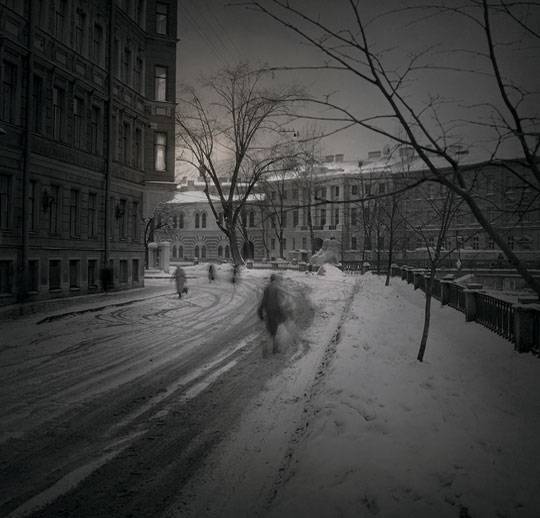
(The ghosts of Leningrad, now St Petersberg, as captured by the great Alexey Titarenko)

By this point in my life, the vast majority of works I’m conducting are ones I’ve already been thinking about for a long time, and already have very strong convictions about. However, one of the delights of the job is that there are always pieces you can leave to discover and explore when an opportunity to perform them comes along. As long as you continue to study and learn new works, the opportunity for a genuine revelation is there.

I’ve always been a Shostakovich nut, but some of the symphonies I’ve known backwards since I was quite young- no.’s 1, 5,8, 9, 10, 12, 14 and 15. The others I have certainly long been aquainted with, but not in the same way- I know them more as a fan, and haven’t had the chance to really figure out what I think about them. This made it all the more exciting when I got the chance to do number 7 last month with the Wrexham Symphony Orchestra.

When I was young, the Leningrad was better known for the crap and nonsense American critics had written about it than for the music itself. The level of sheer invective, usually paired with carefully selected musical excerpts, used out of context, was almost impossible to resist. We grew up being told it was propaganda, that it was film music, that it was banal, self-indulgent, poorly crafted and worse. The “invasion theme” was a huge mistake- a grave manifestation of a lack of taste and professionalism by the composer. Others blamed the material- as if the poor composer was somehow pressured into writing a symphony based on inferior melodies and motives.

I never believed that, but I never quite bonded with the piece as I did with its sister work, the 8th. The 8th begins with a kind of ruthlessly focused angst, while the 7th sounds a bit naïve at the beginning. The meanderings of the 2nd mvt of the 7th seemed a little perplexing to me, compared to the ferocity of the inner movements of 8.

However, over the years, I heard enough good performances to think I had to figure it out for myself- there was the legendary Bernstein-Chicago recording, which every music lover owned at one point, and I also remember a broadcast of the World Orchestra for Peace and Gergiev at the Proms that was pretty awe-inspiring. I gradually became convinced the piece worked, but I wasn’t sure how or why.

Read more…

  • Share/Bookmark

Shostakovich 7- the city, the year, the performance

February 17th, 2010 3 comments

(The ghosts of Leningrad, now St Petersberg, as captured by the great Alexey Titarenko)

For all that readers are seeing a lot about Gustav Mahler on these pages, the work on my desk right now is Dmitri Shostakovich’s 7th Symphony, which I am conducting next week.

I hope that I’ll have time to write in detail about the piece, which is proving to be a revelation in spite of the fact that I’ve loved Shostakovich’s music all my life. As I try to unravel the layers upon layers of references, meanings, allusions and ciphers in the piece, I’ve been scouring books, articles and webpages for help and insight- mostly in vain. In spite of the fact that Shostakovich is probably the most performed composer born in the 20th century, and probably also the most written about and discussed, most of what is out there is not very helpful. There is too much ranting about politics and not enlightening enough music.

I did, however, find a remarkable article on the Guardian website (originally published in The Observer in 2001) by Ed Vulliamy. The rather lame title, Orchestral Maneuvers, doesn’t give you any sense of what the lenthy two-part feature is about- a dramatic retelling of the story of the Lenningrad premiere of Shostakovich 7. It’s a story that, in it’s sanitized and shortened form, appears in almost every program note for the piece, but this account shook me. I link to it today as I know some of my colleagues in the orchestra read this blog, and I’m sure they’ll want to read it before we perform the piece next week.

So, how bad was the winter of 1941-2, the peak of the siege of Leningrad? Part I sets the scene in horrifying detail.

Read more…

  • Share/Bookmark

An instant connection

July 21st, 2006 No comments

Last August, Suzanne and I spent our holiday time traipsing around Normandy and Brittany. One afternoon, we found ourselves in a beautiful and unspoiled little medieval town in western Brittany looking rather aimlessly about. Having quickly found the market and the castle as well as a few other obvious “sights,” we were on the verge of running out of stuff to do. As we sought a bit of shade on a narrow little side-street, we passed a rather dilapidated old house with a hand made sign outside that said “Gallerie.” Having nothing else to do, and seeking further relief from the August heat, we stepped in. Although all décor had been removed, the space was still very much a house. Walls remained where they had been, and there were still plumbing fixtures on the walls of some rooms. The entrance of the building was all peeling paint and cracked plaster, but as we followed the signs upstairs, there were signs of recent painting (all white, of course) and wonderfully bare, old floor boards.

As it happened, there were two exhibits on, both of photography. The first was by a Russian artist I had never heard of. Within moments, though, I knew we’d stumbled onto something very special, and then, less than a minute after I entered I saw two photographs in quick succession that both gave me the exquisite, heart-in-throat feeling of experiencing art that is raw, alive, terrifying, essential- that feeling of seeing an image in the world that has been buried, unseen, in your own subconscious for all your life. The first was this one

-

The artist was Alexey Titarenko.

We spent the next couple of hours very quietly looking. Looking and somehow changing as we absorbed these images of life, death, despair, menace and mystery. I was so moved and impressed that I did something I never do at museums and galleries, possibly because I feared I’d never see his stuff again. I bought the book!

We kept it safe in a corner of our little car so it wouldn’t get smashed by camping equipment until we got back to Cardiff. Even then, it was a few weeks before I finally took the shrink wrap off and read the book. I was a bit nervous that the photographs couldn’t possibly be equal to that first experience where it seemed like my heart was both racing and stopping. Fortunately, these are images that endure and haunt, and I’ve enjoyed the book immensely.

Imagine, then, my reaction when I discovered that music was a huge influence on Titarenko’s work. According to the book, his picture “The Black and White of Saint Petersburg” was inspired by the Brahms Violin concerto, and that, for him each musical piece, and its conveyance of the state of mind of the composer, affects how he sees a city or a landscape. In particular, one composer seems to have had a huge influence on Titarenkos approach and that is Dmitri Shostakovich. In particular, the Second Cello Concerto has “provided the underlying rhythm for the photographer’s inspiration.” In the artists words “I was so hooked on this concerto, that I could listen to it all day, every day. During my walks around the city, I realized that St. Petersburg offered endless living illustrations of this music. The monotonous opening cello melody was one of despair, but also of expectation. The concerto was instrumental in realizing certain images.” Fascinating. To me, this is probably the greatest cello concerto ever written. For all the glories of the Dvorak and the poignancy of the Schumann, even for Shostakovich’s own, brilliant First Concerto, to me, this work is the most essential work written for cello and orchestra, because, at least to me, its message is so important. It is music that is the singing conscience of a destroyed culture, and a very precious reminder of the frailty of humanity. It’s personal and universal messages are perfectly embodied in the juxtaposition of solo cello and orchestra. Few other works, maybe the Beethoven Violin Concerto, Berg Violin Concerto and the greatest Mozart Piano Concerti find this balance so perfectly. In any case, to what extent could my powerful reaction to Titarenko’s images be due to the fact that we shared this common love of one piece of music? How does music change us, imprint its layers of meaning on us? Perhaps I was carrying these images in my subconscious, not from birth, but from Shostakovich, or perhaps all three of us, and all of you, have always carried them inside us, but that only the true artist could bring them out into the world were we could all look or listen and say, “yes, I know this.”

More on Alexey Titarenko, including an interview in mp3 format.

c. 2006 Kenneth Woods

  • Share/Bookmark