

Composer – John Joubert
Libretto – Kenneth Birkin
Director – Eleanor Burke
Conductor: Kenneth Woods
Orphaned Jane is forced to live with her abusive relatives and locked in a terrifying red room, then sent to strict Lowood school, where her only close friend dies of consumption. These opening sections of Charlotte Brontë’s celebrated novel are already traumatic memories. The opera starts as Jane is leaving Lowood, where she is now a teacher, to become a governess at mysterious Thornfield Hall.
This production makes musical history as the first staging of an opera that has only previously been heard in a concert hall. The characters wear full Victorian dress, but some sequences are symbolic rather than naturalistic. This operatic fever dream based on Brontë’s Jane Eyre assumes some knowledge of the original text, and the first half might be hard to follow if you hadn’t at least skim-read a synopsis.
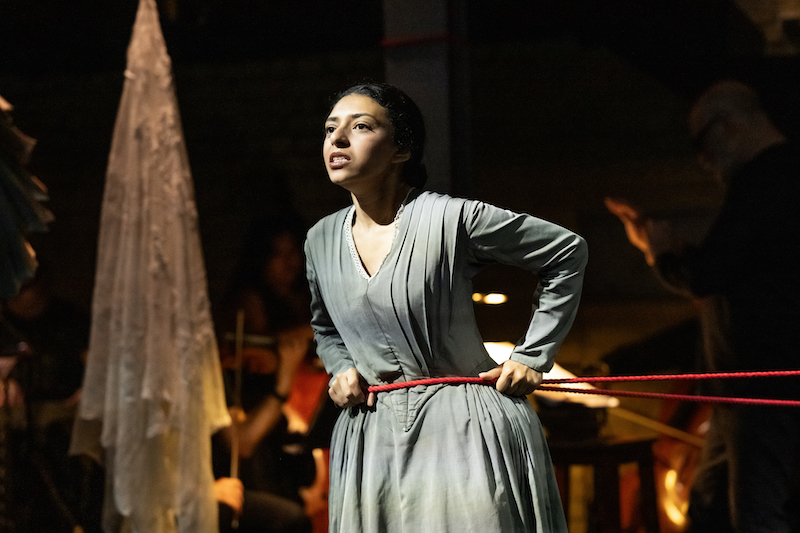
Site-specific designer Emeline Beroud has hung several significant items on red ropes above the stage: keys, school books, maps, a wedding veil, a bare branch and a chalkboard with LIAR written on it. On the back, the chalkboard reads Helen Burns 1821-1835. These items, plus an old school desk, are the only set. Keys, red threads, and ropes are recurring motifs, variously representing the freedom, empowerment, disempowerment, fire…
The first distinct character we encounter is Bertha Mason, Edward Rochester’s first wife, who is famously imprisoned in the attic. Contemporary dancer Steffi Fashokun gives a powerful, poignant and silently persuasive performance as the troubled and enigmatic Bertha. She is continually present throughout the first half on a mezzanine balcony, where she appears, like Penelope or the tower-bound Lady of Shalott, to be weaving a tapestry or visceral rag rug in various shades of red. Tapestry Maker Juliette Georges has created an extraordinary artwork for Fashokun to run mad with. Movement director Alex Gotch effectively creates an alternative narrative for her through expressive choreography.
John Joubert’s opera Jane Eyre, written over ten years in the late twentieth century with librettist Kenneth Birkin, premiered as a concert in 2016. This production, part of 2025’s Grimeborn Festival, is its first full staging. It’s an imaginative production, where psychological drama is more important than externalities. Egyptian soprano Laura Mekhail, as the eponymous Jane, has a soaring, emotional range. Her radiant directness embodies Brontë’s revolutionary focus on her Jane’s individual choices and experiences: “I am a free human being, with an independent will.”
Mekhail has a stillness and wonder about her as she watches the sunset, and a nice range of sceptical expressions as she listens to tenor Lawrence Thackeray (playing an impassioned St John Rivers) mansplaining God to the women around him. Baritone Hector Bloggs makes a sympathetic and vulnerable Rochester, and his love scenes with Jane are genuinely moving.
Five other singers double up to play all the other characters, and Joubert’s 35-strong orchestra has become a chamber ensemble. Thomas Ang has arranged the opera for string quartet, horn, and others, all sensitively led by Kenneth Woods, who also conducted the 2016 concert premiere.
Director Eleanor Burke sees Jane Eyre as a story of resistance and resilience in the face of systemic injustice and oppression. “It’s not just about one woman’s struggle,” Burke tells Gramophone magazine. “The society around her … are all complicit.” The words often illustrate these underlying themes (“Cast off your chains!” sings Jane) rather than quoting directly from the novel. Spoken, they might sound trite, but the music transforms them into something transcendent. The duet between Jane and Rochester, which closes the first half, delicately echoes their shared love: “to be alive, today, is wonderful, wonderful…”
Runs until 9 August 2025
I’d enjoy hearing a performance
Thanks, Bill! There is the live recording of the concert premiere here
https://tidal.com/album/284080477/u