Description
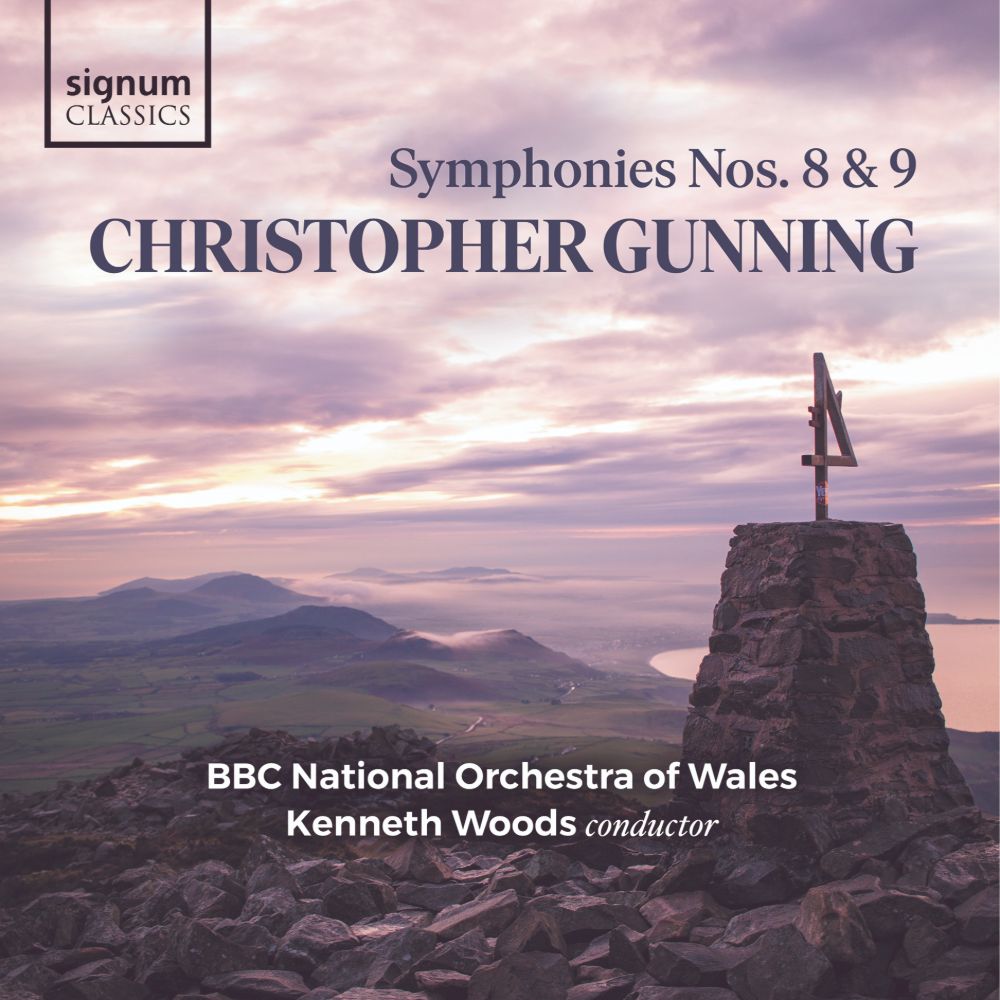
Christopher Gunning: Symphonies Nos. 8 & 9
Price range: £8.00 through £14.00
Four-time BAFTA winning composer Christopher Gunning, has composed twelve symphonies as well as concertos for the piano, violin, cello, flute, oboe, clarinet, saxophone, and guitar. Here the BBC National Orchestra of Wales and conductor Kenneth Woods, perform his eighth and ninth symphonies, recorded in Hoddinott Hall in March 2024.
“Each scored for a moderately sized orchestra (the 8th has only one trumpet and no lower brass, while the 9th adds a second trumpet, a harp, and a small percussion section) and both [grapple], in Gunning’s highly individual way, with the legacy of classical symphonic form” – Richard Bratby.
[9th Symphony] “I believe this piece has a strong emotional flavour but if you try and untangle the story you’re going to end up with your own story – and to me, that is absolutely perfect.” – Christopher Gunning.
★★★★ – BBC Music Magazine
“This is well worth acquiring by those who are not yet acquainted with Gunning’s symphonic odyssey.” – Arcana
“This recording not only establishes Christopher Gunning as an essential symphonic composer of our time, but also confirms Kenneth Woods as one of the most refined and intelligent conductors in the field of contemporary music.” – Sonograma
“Gunning’s […] symphonies, numerous concertos and sundry orchestral pieces are as meticulously wrought as they are powerfully conceived.” – Gramophone
Admin –
From Klassisk Magazine (Translated from the Norwegian)
https://www.klassiskmusikk.com/cd-anmeldelser/christopher-gunning-hes-the-right-one/
Although the name of British composer Christopher Gunning (1944-2023) is probably unknown, moviegoers and television viewers from the 1970s-90s have certainly heard his music.
Written by Guy Rickards, translated by Hilde Holbæk-Hanssen
His undoubted talent for catchy melodies earned him a career composing for advertising, whether it was Black Magic chocolate or – most famously – the long-running Martini adverts for which he wrote the tune ” It’s the Right One” . Later, Gunning moved on to the television programmes for which these adverts were made, writing, among other things, the sly, nocturnal theme for Agatha Christie’s Poirot (starring David Suchet).
After the turn of the millennium, Gunning returned to his childhood love; serious classical composition, and became a symphonist. His dynamic Symphony No. 1 (2001) had twelve successors, the last in 2023. He wrote chamber music and concertos in parallel, one of which – for oboe (2004) – was recorded by his daughter, Verity, at Chandos, together with Symphonies Nos. 3 and 4. (CHAN 10525). Gunning’s conception of symphonic form was the structures and processes of the story-teller in a non-programmatic way. “I think,” he once said, “that music, with some exceptions, does not behave at its best when it tries to be specific. It is much better when it is about feelings; and general feelings at that.” His approach is therefore closer to that of the award-winning British film composer and symphonist, Malcolm Arnold, also a fine melodist, than – for example, Stravinsky, who claimed that music did not express anything like a horse!
Gunning’s 8th (2014-5) and 9th (2015-6) symphonies make a fine but contrasting pair, composed for fairly small orchestras without heavy brass and with modest percussion. His more commercial music tended to feature elaborate scores, but his symphonies (“music that is relatively easy to follow” was intended “to communicate,” he claimed) needed clarity. Both have a slightly pastoral, open character that is in a way quite English in accent, yet unlike any other composer. The 8th derives entirely from the opening motif, and the three movements – sonata-allegro, adagio in the middle, and scherzo-finale, a format beloved by the American symphonist Walter Piston – develop this material ingeniously within their individual frameworks. Here Gunning seems to be “negotiating” with classical form in order to derive something new, although I find this the more elusive of the two symphonies. No. 9, on the other hand, has a more outwardly traditional layout, is more immediately appealing than its predecessor, but is very different from the “grand statement” often expected of a ninth symphony, and aligns itself more with Myaskovsky (who superstitiously wrote his tenth at the same time to avoid the “curse of the ninth”; something Gunning did not do!), Havergal Brian or Harald Sæverud. The performances by the BBC National Orchestra of Wales with Kenneth Woods (following up his earlier Signum release of Nos. 2, 10 and 12; SIGCD593) are brilliant. Woods’ conducting is clear and firm in interpretations that could hardly be bettered, especially with such good sound.