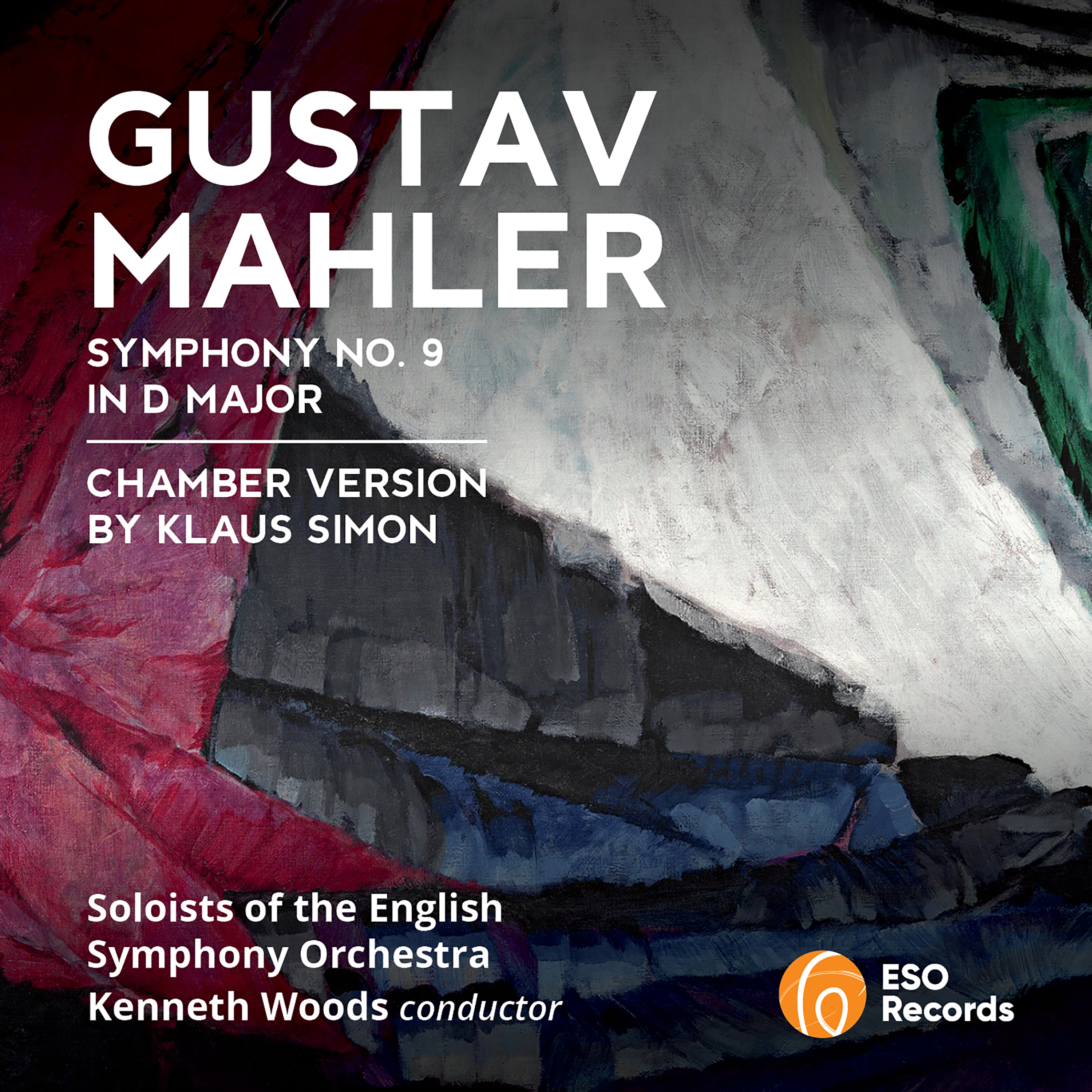
4 reviews for Mahler arr. Klauss Simon – Symphony No. 9. ESO Soloists//Kenneth Woods (ESO Records)
Rated 5 out of 5
admin –
MAHLER: Symphony 9 (chamber version) Soloists of English Symphony/ Kenneth Woods ESO 2602—77 minutes I didn’t expect to like this as much as I do. I mean, why reach for an arrangement of the Ninth cut down to 19 players, when there are dozens of excellent recordings of the more-than-full orchestra original? This reminds me of a likewise “chamberized” version of the Fourth Symphony performed on an Internet stream by the Philadelphia Orchestra during Covid. We were desperate for any “live” music we could hear in those days, so that performance was quite an “event” at the time. In fact, it would have been right around the time this recording was made in March of 2021. So why the Ninth played by a chamber orchestra in this arrangement by German composer Klaus Simon? In his concise, perceptive program notes Peter Davison explains that it makes “…these pieces available to a wider range of performers and audiences”. Well, maybe. But there is no shortage of available recordings of Mahler’s original. “[T]he reduced forces bring new transparency to complex scores. What is lost in the range of color and the dramatic impact of a full symphony orchestra is compensated by revealing inner parts and contrapuntal details.” Ah, with that I will agree! “The Ninth Symphony marked a stepchange in Mahler’s orchestral technique, further developing his use of chamber-like textures and fluid contrapuntal lines. Klaus Simon’s arrangement captures the spirit of Mahler’s unique sound-world without limiting its expressive intensity.” I can agree with all of that, though why “chamber-like” textures are better than the full expressive forces of a symphony orchestra is not entirely clear. The arrangement is indeed rather unusual: string parts are assigned one instrument per part, while the wind complement is much larger, including flute and piccolo (same player), oboe and English horn, 2 clarinets, E-flat clarinet, bass clarinet, bassoon, 3 horns, trumpet, percussion, harmonium, and piano. The result is that the wind parts come thru much more distinctly than they usually do when paired with a full string ensemble. The balances are much different (those 3 horns and all the clarinets!), yet somehow the string parts remain very distinct and do not come off that unbalanced. It really does work as one large, 80-minute, 4-movement chamber piece. All the playing is outstanding—as it has to be, with so many exposed lines—and the recorded sonics are first rate, too. I’m not sure when—or IF—I will reach for this disc to hear the Mahler Ninth, but it certainly turned out to be a rewarding experience. HANSEN
Rated 5 out of 5
Kenneth Woods –
MAHLER Symphony No. 9 (arr. Simon) • Kenneth Woods, cond; English SO • ESO 2602 (76:52)
Let me say at once that if you want the finest account imaginable of Klaus Simon’s “chamber” version of Mahler’s Ninth Symphony, this is it. The talented soloists of the English Symphony Orchestra play magnificently throughout what must have been exhausting and intense recording sessions, and Kenneth Woods is one of the most intuitive and visionary conductors of Mahler around. But—and I mean no disrespect at all to these musicians—why would you want to add Simon’s version to your already overflowing shelves of Mahler 9s? The liner notes assert that this arrangement “captures the spirit of Mahler’s unique sound-world without limiting its expressive intensity,” and Simon has written elsewhere that he believes that rescoring Mahler for small forces enables “a new and slimmer, even clearer, listening experience.” Hmm. Well, slimmer, yes. The corresponding woodwind and brass parts in Simon are stripped right back: for example, four flutes down to one, ditto oboes and bassoons, three trumpets to one. His arrangement permits a larger group of strings, but here there are just single instruments for each part. And, crucially, no trombones, tuba, or harp. Piano and harmonium are added to make up for the gaps. No harp! I can’t be the only listener for whom those first accented four notes from the harp right at the start of the work define something very special about its timbre. Simon offers us a piano, heroically played but unmistakably a piano, and deadeningly synthetic for anyone who knows the original. And so, the claim about the arrangement capturing the “spirit” of the Mahler sound falls at the first and never quite recovers. Without trombones or tuba, the first movement’s furious collapse at Mit Wut. Allegro risoluto, and the Rondo-Burleske’s brass writing have no floor. The string quintet in the Adagio is superb but, well, it’s a quintet. I could go on.
Simon’s claims about clarity are odd, I think. First, in any of the great modern accounts of the work, Karajan live in Berlin in 1982, Abbado in Lucerne in 2010, Fischer and his Budapest forces in 2013, the contrapuntal playing is staggering, the textures limpidly held throughout. Here, for all the obvious focus on line, my impression of the sound is more like something prepared for a lecture on Mahler’s counterpoint, as if that technical achievement in and of itself were the thing to focus on. It’s not. As for “expressive intensity,” it pervades the performance—to say again, I really can’t speak more highly of players or conductor. It’s just not quite the same type of intensity as an orchestral performance. My sense of the Adagio in particular is of Woods having to press tempos because of the thinness of his forces and the sheer difficulty that practical limitation poses. Abbado can take 28 minutes with a fully sustained string section. Woods builds something else, an edginess where we might expect serenity. It’s not inauthentic exactly, but certainly unsettling.
Now although the booklet doesn’t assist much, a bit of research as to provenance does help. The recording was made five years ago in March 2021. It was the ESO’s first gathering since the second UK COVID-19 lockdown. I said above that these must have been exhausting sessions, no doubt emotional too. As was the case with many ensembles, ESO was doing its resourceful best, and I believe a recording of the performance was streamed in July of that year to coincide with Mahler’s birthday. A lovely gift, then, but one which in the long five years that have elapsed has lost its relevance now that we’re happily able to enjoy hearing the symphony in its normal form. Indeed, I note there’s a forthcoming version by one Kenneth Woods from the Colorado MahlerFest.
One more thing. The liner notes set up what I think is a wholly misconceived programmatic view of the symphony. Peter Davison’s thesis, if that isn’t too grand a term for it, is that The Brothers Karamazov was one of Mahler’s favorite books and that the symphony maps out the contrasting “worldviews” between two of the brothers, Alyosha and Ivan. We of course know that Mahler admired The Brothers Karamazov. His view of Dostoevsky came via a close friend, Nina Hoffmann-Matscheko, Dostoevsky’s first German biographer. Given the access to her insight, it seems to me highly unlikely that Mahler’s reading of the book possessed the profound limitations that Davison’s excitable theory implies. There are three brothers in the book, arguably four. The two-term idealist/cynical scheme silently deletes Dmitri, a foundational character, and Smerdyakov, who is the one who acts on Ivan’s ideas. Remove those two and there is no moral drama left, only an artificial debate with two speakers. I just don’t see Mahler reaching for such a fallacious reading and there is of course absolutely no evidence for it. Oh, and does the Ninth need a program? I don’t think so. Lecture over, you’re not at the New York Review of Books, although doubtless many Fanfare readers wish I were. Dominic Hartley
The prospect of a chamber version of Mahler’s Ninth Symphony would lie somewhere between strange and laughable except for its predecessors. Vienna after World War I was filled to bursting with new music, and in 1918 Arnold Schoenberg and a group of others founded the Society for Private Musical Performance, which survived through subscriptions until 1921. Knowing this, what I didn’t know was that in those few years the Society put on nearly 120 concerts featuring 150 contemporary works. Therefore, the legacy of this enterprise is misleading, because what we remember are the reduced versions of Mahler’s music that have been recorded in our own time.
The two that many readers will be aware of are Symphony No. 4 and Das Lied von der Erde, which have attracted a few major conductors and singers. A notable recording of the symphony is Daniel Harding’s from 2005 with the Mahler Chamber Orchestra (Virgin). Satisfying versions of the chamber Das Lied are much harder to find, in no small part because the vocal writing is just as challenging as in the fully orchestrated version. That would be much less so in the Lieder eines fahrenden Gesellen in Schoenberg’s reduction, and if you can find it, there’s a passionate account from mezzo Hélène Lindqvist with Peter Stangle and the Taschenphilharmonie, or Pocket Philharmonic, on Preiser. (At present a good-sounding video is on YouTube.)
American conductor Kenneth Woods has been artistic director of the Colorado MahlerFest since 2015 and of the English Symphony Orchestra since 2013. He has recorded both of the two Mahler vocal works in chamber arrangements. Now he risks going a bridge too far with Klaus Simon’s reduction of the Mahler Ninth for the Society. The chances of success are reduced by two factors. First, although Das Lied von der Erde calls for an oversized orchestra on the same scale as Symphony No. 9, the two singers help to distract us from the thin instrumentation of the chamber version. Second, and more critically, Woods has chosen to use one player for each string part, even though Simon doesn’t explicitly call for this; he leaves the numbers of string flexible.
If you find it improbable to hear a total of 19 players in this score, I’ll join you. Simon makes the most of the ensemble through extensive doubling. Strings aside, his arrangement calls for flute/piccolo, oboe/cor anglais, two clarinets (one player doubling E? clarinet and one doubling bass clarinet), bassoon, three horns, trumpet, percussion, harmonium, and piano. What this comes down to, practically speaking, is a string quintet overwhelmed by a sizable complement of woodwinds and brass, with the piano filling in missing lines to give a fuller effect.
Woods conducts with considerable skill, and as an interpretation per se, this one can certainly pass muster. Moreover, the musicians of the ESO participate with eager commitment—the orchestra, which is merged with the English String Orchestra, is situated in the West Midlands in the small city of Worcester. Woods takes a relaxed tempo in the Rondo-Burleske that doesn’t test the players’ execution, and there are passing moments in all four movements that sound right, or at least not as wrong as the whole conception. A roomy acoustic adds body to the string quintet at the opening of the Adagio.
Still, the necessity to give the Mahler Ninth a reduced footprint is long past, and Woods’s sensitivity is in aid of a forgotten cause. It would be fascinating to expose someone who has never heard the real thing to this chamber version in order to see if it holds its own independently. But none of us have ears innocent of the Mahler Ninth, which makes Simon’s arrangement an archival curiosity. Huntley Dent
Mahler Symphony9 ESORecords
Gustav Mahler (1860-1911)
Symphony No. 9 in D major (1909, arr. Klaus Simon for chamber ensemble)
Soloists of the English Symphony Orchestra/Kenneth Woods
rec. 2021, Wyastone Concert Hall, Monmouth, UK
ESO Records ESO2602 [77]
The inspiration for this arrangement of Mahler’s Ninth by the German composer, Klaus Simon surely lies in The Society for Private Musical Performance (Verein für musikalische Privataufführungen) which Arnold Schoenberg and a group of like-minded individuals, including Alban Berg and Anton Webern, established in Vienna in 1918. The Society put on, I believe, 117 concerts between 1919 and 1921, and at these concerts some 150 works by contemporary composers were performed. The aim was to give an opportunity for people to hear new or recently composed works at a time when music lovers did not have the ready access to music through broadcasts and recordings which nowadays we take for granted. Although small scale works were most often performed, the Society also gave a hearing to larger scale works in arrangements for chamber forces. One such arrangement was Erwin Stein’s 1921 reduction for chamber ensemble of Mahler’s Fourth symphony. I’ve heard a couple of recordings of this (review ~ review). Schoenberg himself made a reduced version of Lieder eines fahrenden Gesellen in 1920. In the following year he began, but did not complete, an arrangement of Das Lied von der Erde; in the early 1980s, Schoenberg’s work on the score was completed by Rainer Rhien. Kenneth Woods recorded both of these arrangements in 2010; though I’ve not heard that disc, my colleague Dan Morgan greeted it enthusiastically (review).
The last time I heard Mahler’s Ninth was a few weeks ago when I was reviewing the complete cycle of the symphonies played by the Czech Philharmonic conducted by Semyon Bychkov. The present CD arrived as I was putting the finishing touches to my Bychkov review and I made a conscious decision to leave a gap of a few weeks before listening to Simon’s arrangement of the score. I have tried, thereby, to come to this disc as freshly as possible, though I have to admit that having known and hugely admired Mahler’s Ninth for the best part of sixty years it is very difficult to get what I might term its ‘conventional’ sound out of my head.
I should start by outlining the forces for which Simon has re-scored the symphony. In this performance, each of the five string parts is played by one musician (I infer from the wording in the booklet that this may be a performance decision and that Simon did not necessarily specify just one player per desk). Simon also employs flute/piccolo, oboe/cor anglais, two clarinets (one player doubling E-flat clarinet and one doubling bass clarinet), bassoon, three horns, trumpet, percussion (one player), harmonium, and piano.
Mahler’s Ninth is a really demanding score for orchestral players but its challenges must be magnified greatly when you are one of just 19 performers; there is nowhere to hide. I should say at once that the members of the English Symphony Orchestra who we hear in this performance play with great distinction. Much of Mahler’s writing leaves them very exposed in this reduced scoring but they rise to all the challenges that Mahler and Klaus Simon set them. Kenneth Woods conducts the music very well indeed. There may have been one or two occasions where, subjectively, I queried a tempo selection but Woods is a highly experienced and authoritative Mahler conductor and that experience is very evident here; he understands the music completely.
However, for all the excellence of the performance and interpretation per se I cannot disguise that I have significant reservations about Klaus Simon’s arrangement of the symphony. I hasten to say that his reduced scoring seems to me to have been done skilfully and from the standpoint of someone who understands Mahler’s music very well indeed. That said, while some parts of the arrangement work well, my principal concern, as I listened, was that too often the music sounded thin. In the booklet, there is a note about Simon’s arrangement which includes the statement that “the reduced forces bring new transparency to complex scores. What is lost in the range of colour and the dramatic impact of a full symphony orchestra is compensated by revealing inner parts and contrapuntal details”. I understand that and, up to a point, I agree. However, I think one or two points need to be made in response. Firstly, do we actually need reduced scoring to enable the listener to hear details, especially in a recording? A skilled conductor and players – as we have here – and expert recording engineers can reveal inner detail. I looked back to my review of Semyon Bychkov’s recording of the Ninth and I saw that I had made this specific comment: “As I listened, I was thrilled by the amount of detail which is audible in a very natural way”. Furthermore, I think there’s a case to be made that in Simon’s reduction one can hear too much detail at times; did Mahler intend all the inner detail to come through with such clarity or did he regard some of the detail as subsidiary? Secondly, one of the glories of Mahler’s original scoring is that so often his textures, especially in the outer movements, are delicate, spare and refined; there’s already a chamber-like intimacy to many passages, especially in the first movement. This means that when he unleashes the full power of the orchestra the contrast with the more intimate passages is profound; I think you lose much of that contrast here. And the reverse is true. At the start of the fourth movement, I missed the tonal weight of a full string section, even though I admired the warmly expressive playing of the five string players. But, for me, this slimmed-down texture then compromised the effect of the last few minutes of the symphony. As the symphony draws to a close, Mahler requires his strings to play with the utmost delicacy – which the five musicians of the ESO achieve. The trouble is, we’ve already heard just five string players at the start of the movement and during it. So, for me, the impact of the last few minutes is lessened, despite the skill and sensitivity of the quintet of string players.
I thought Simon’s arrangement of the second movement worked rather well. Woods takes the Ländler at quite a swift pace – which I like – and his players achieve excellent rhythmic lift. Throughout this movement, the playing is spirited and precise. Unsurprisingly, the textures are admirably clear. The music-making is lithe and razor-sharp. Rather to my surprise, I was more convinced than I expected to be by the Rondo-Burleske. Yes, I do miss the tonal weight of the lower strings and of the heavy brass but, on the other hand, the performance is biting and punchy, which is what the music needs. The lyrical passage that the trumpet leads off (from 6:24) is played at a nicely flowing tempo, which means that sentimentality is avoided. When the Rondo returns at full tilt, I admired the way the woodwind lines cut through but the orchestra sounds a bit too bright – that’s not the players’ fault; it’s a function of the scoring – and I definitely missed the timpani part in the closing stages (from 12:33); having the timpani notes played on the piano is a poor substitute.
In the concluding Adagio there’s no doubting the intensity with which the members of the ESO play the music, though I do wonder if the horns are not too prominent in the section after the movement’s climax (from just before 13:00). In Mahler’s original scoring, the horns ring out gloriously but they’re set against a full string section; here, their sound is too dominant, I feel. As I’ve already mentioned, the way the closing pages are played (from 17:08 onwards) is very fine and, indeed, eloquent, on its own terms but to my ears Simon’s reduced scoring doesn’t give us a sufficient, drained contrast with everything that has preceded these last few minutes.
I did some internet research to see if I could learn more about Simon’s arrangement of the Ninth and, specifically, about the scoring. I couldn’t find any details relating to the Ninth but on the website of Universal Edition, I discovered that for his arrangements of the Fifth and Sixth symphonies, the forces specified include maximum strings as follows: 6/5/4/3/2 (though it appears that single-desk forces are also permissible). I wonder if Kenneth Woods has here recorded the arrangement of the Ninth using the minimum forces; might I have felt differently about Simon’s work on the score if I’d heard it with a few more string players?
Notwithstanding my reservations about Klaus Simon’s arrangement, I think one other important point should be made. Earlier in this review, I quoted part of the booklet note which references the increased transparency and the clarity which the reduced scoring brings. In the same essay we read that his arrangements of works requiring large forces make such works “available to a wider range of performers and audiences”. In these financially challenging times for the performing arts, certainly in the UK, it’s an expensive undertaking to assemble the full forces required to perform Mahler’s symphonies. So, Klaus Simon’s arrangements bring a financial benefit. Furthermore, they make it possible for chamber-sized groups of musicians to perform the music in smaller halls, including venues situated at some distance from big cities. So, if Klaus Simon’s arrangements widen access for great works such as Mahler’s symphonies that’s all to the good.
Which leads us back to the present recording. It’s worth the attention of Mahler devotees as it shines a fresh light on one of his greatest works. In addition, it will raise awareness of this arrangement; that may induce other ensembles and concert promoters to take it up. Certainly, Kenneth Woods and his colleagues make a good case for the arrangement. That said, Klaus Simon’s arrangement doesn’t by any means give us the full story of Mahler’s Ninth. Arguably, that was never his aim; rather, his intention was to shed a different light on one of the greatest symphonic works of the twentieth century and increase accessibility to it. I’ve found it intriguing to hear, though I’m not really persuaded. I do hope, though, that one day I’ll get to hear Woods conduct the Ninth in Mahler’s full scoring.
It seems that there have been at least two previous recordings of the Klaus Simon arrangement. I ought particularly to draw attention to a 2014 recording by Ensemble Mini and Joolz Gale, which my colleague Dominy Clements reviewed in 2015. It’s appropriate to reference Dominy’s review for two reasons. Firstly, it seems that it was Joolz Gale who commissioned Simon to make this arrangement. Secondly, and more relevantly in the context of my review, it should be noted that Dominy was more enthusiastic than me about the Simon arrangement: he described it as “something of a voyage of rediscovery”. I’m mildly puzzled that Dominy mentions the presence of an accordion in the ensemble; maybe that’s an alternative to the harmonium that Woods uses. Dominy references another version, which involves a group of players from the Royal Concertgebouw Orchestra, Camerata RCO conducted by Gustavo Gimeno (Gutman Records). I looked that up online and saw that this version uses almost identical forces to those used by Woods – in view of my earlier comment about the size of the string section, it’s noteworthy that Gimeno also uses just five string players. There appear to be two differences of instrumental forces: Gimeno also uses an accordion rather than a harmonium and he has just two horns to Woods’ three.
The recording has been produced by Phil Rowlands and engineered by Tim Burton. They’ve done a good job, maximising the clarity of Simon’s scoring, albeit the microphone placings are perhaps a bit on the close side. The anonymous booklet notes are very useful.
admin –
MAHLER: Symphony 9 (chamber version) Soloists of English Symphony/ Kenneth Woods ESO 2602—77 minutes I didn’t expect to like this as much as I do. I mean, why reach for an arrangement of the Ninth cut down to 19 players, when there are dozens of excellent recordings of the more-than-full orchestra original? This reminds me of a likewise “chamberized” version of the Fourth Symphony performed on an Internet stream by the Philadelphia Orchestra during Covid. We were desperate for any “live” music we could hear in those days, so that performance was quite an “event” at the time. In fact, it would have been right around the time this recording was made in March of 2021. So why the Ninth played by a chamber orchestra in this arrangement by German composer Klaus Simon? In his concise, perceptive program notes Peter Davison explains that it makes “…these pieces available to a wider range of performers and audiences”. Well, maybe. But there is no shortage of available recordings of Mahler’s original. “[T]he reduced forces bring new transparency to complex scores. What is lost in the range of color and the dramatic impact of a full symphony orchestra is compensated by revealing inner parts and contrapuntal details.” Ah, with that I will agree! “The Ninth Symphony marked a stepchange in Mahler’s orchestral technique, further developing his use of chamber-like textures and fluid contrapuntal lines. Klaus Simon’s arrangement captures the spirit of Mahler’s unique sound-world without limiting its expressive intensity.” I can agree with all of that, though why “chamber-like” textures are better than the full expressive forces of a symphony orchestra is not entirely clear. The arrangement is indeed rather unusual: string parts are assigned one instrument per part, while the wind complement is much larger, including flute and piccolo (same player), oboe and English horn, 2 clarinets, E-flat clarinet, bass clarinet, bassoon, 3 horns, trumpet, percussion, harmonium, and piano. The result is that the wind parts come thru much more distinctly than they usually do when paired with a full string ensemble. The balances are much different (those 3 horns and all the clarinets!), yet somehow the string parts remain very distinct and do not come off that unbalanced. It really does work as one large, 80-minute, 4-movement chamber piece. All the playing is outstanding—as it has to be, with so many exposed lines—and the recorded sonics are first rate, too. I’m not sure when—or IF—I will reach for this disc to hear the Mahler Ninth, but it certainly turned out to be a rewarding experience. HANSEN
Kenneth Woods –
MAHLER Symphony No. 9 (arr. Simon) • Kenneth Woods, cond; English SO • ESO 2602 (76:52)
Let me say at once that if you want the finest account imaginable of Klaus Simon’s “chamber” version of Mahler’s Ninth Symphony, this is it. The talented soloists of the English Symphony Orchestra play magnificently throughout what must have been exhausting and intense recording sessions, and Kenneth Woods is one of the most intuitive and visionary conductors of Mahler around. But—and I mean no disrespect at all to these musicians—why would you want to add Simon’s version to your already overflowing shelves of Mahler 9s? The liner notes assert that this arrangement “captures the spirit of Mahler’s unique sound-world without limiting its expressive intensity,” and Simon has written elsewhere that he believes that rescoring Mahler for small forces enables “a new and slimmer, even clearer, listening experience.” Hmm. Well, slimmer, yes. The corresponding woodwind and brass parts in Simon are stripped right back: for example, four flutes down to one, ditto oboes and bassoons, three trumpets to one. His arrangement permits a larger group of strings, but here there are just single instruments for each part. And, crucially, no trombones, tuba, or harp. Piano and harmonium are added to make up for the gaps. No harp! I can’t be the only listener for whom those first accented four notes from the harp right at the start of the work define something very special about its timbre. Simon offers us a piano, heroically played but unmistakably a piano, and deadeningly synthetic for anyone who knows the original. And so, the claim about the arrangement capturing the “spirit” of the Mahler sound falls at the first and never quite recovers. Without trombones or tuba, the first movement’s furious collapse at Mit Wut. Allegro risoluto, and the Rondo-Burleske’s brass writing have no floor. The string quintet in the Adagio is superb but, well, it’s a quintet. I could go on.
Simon’s claims about clarity are odd, I think. First, in any of the great modern accounts of the work, Karajan live in Berlin in 1982, Abbado in Lucerne in 2010, Fischer and his Budapest forces in 2013, the contrapuntal playing is staggering, the textures limpidly held throughout. Here, for all the obvious focus on line, my impression of the sound is more like something prepared for a lecture on Mahler’s counterpoint, as if that technical achievement in and of itself were the thing to focus on. It’s not. As for “expressive intensity,” it pervades the performance—to say again, I really can’t speak more highly of players or conductor. It’s just not quite the same type of intensity as an orchestral performance. My sense of the Adagio in particular is of Woods having to press tempos because of the thinness of his forces and the sheer difficulty that practical limitation poses. Abbado can take 28 minutes with a fully sustained string section. Woods builds something else, an edginess where we might expect serenity. It’s not inauthentic exactly, but certainly unsettling.
Now although the booklet doesn’t assist much, a bit of research as to provenance does help. The recording was made five years ago in March 2021. It was the ESO’s first gathering since the second UK COVID-19 lockdown. I said above that these must have been exhausting sessions, no doubt emotional too. As was the case with many ensembles, ESO was doing its resourceful best, and I believe a recording of the performance was streamed in July of that year to coincide with Mahler’s birthday. A lovely gift, then, but one which in the long five years that have elapsed has lost its relevance now that we’re happily able to enjoy hearing the symphony in its normal form. Indeed, I note there’s a forthcoming version by one Kenneth Woods from the Colorado MahlerFest.
One more thing. The liner notes set up what I think is a wholly misconceived programmatic view of the symphony. Peter Davison’s thesis, if that isn’t too grand a term for it, is that The Brothers Karamazov was one of Mahler’s favorite books and that the symphony maps out the contrasting “worldviews” between two of the brothers, Alyosha and Ivan. We of course know that Mahler admired The Brothers Karamazov. His view of Dostoevsky came via a close friend, Nina Hoffmann-Matscheko, Dostoevsky’s first German biographer. Given the access to her insight, it seems to me highly unlikely that Mahler’s reading of the book possessed the profound limitations that Davison’s excitable theory implies. There are three brothers in the book, arguably four. The two-term idealist/cynical scheme silently deletes Dmitri, a foundational character, and Smerdyakov, who is the one who acts on Ivan’s ideas. Remove those two and there is no moral drama left, only an artificial debate with two speakers. I just don’t see Mahler reaching for such a fallacious reading and there is of course absolutely no evidence for it. Oh, and does the Ninth need a program? I don’t think so. Lecture over, you’re not at the New York Review of Books, although doubtless many Fanfare readers wish I were. Dominic Hartley
Kenneth Woods –
MAHLER Symphony No. 9 (arr. Simon) • Kenneth Woods, cond; English SO • ESO 2602 (Streaming audio: 77:00) https://music.apple.com/us/album/mahler-symphony-no-9-in-d-major-gmw-50-arr-for-chamber/1871004478
The prospect of a chamber version of Mahler’s Ninth Symphony would lie somewhere between strange and laughable except for its predecessors. Vienna after World War I was filled to bursting with new music, and in 1918 Arnold Schoenberg and a group of others founded the Society for Private Musical Performance, which survived through subscriptions until 1921. Knowing this, what I didn’t know was that in those few years the Society put on nearly 120 concerts featuring 150 contemporary works. Therefore, the legacy of this enterprise is misleading, because what we remember are the reduced versions of Mahler’s music that have been recorded in our own time.
The two that many readers will be aware of are Symphony No. 4 and Das Lied von der Erde, which have attracted a few major conductors and singers. A notable recording of the symphony is Daniel Harding’s from 2005 with the Mahler Chamber Orchestra (Virgin). Satisfying versions of the chamber Das Lied are much harder to find, in no small part because the vocal writing is just as challenging as in the fully orchestrated version. That would be much less so in the Lieder eines fahrenden Gesellen in Schoenberg’s reduction, and if you can find it, there’s a passionate account from mezzo Hélène Lindqvist with Peter Stangle and the Taschenphilharmonie, or Pocket Philharmonic, on Preiser. (At present a good-sounding video is on YouTube.)
American conductor Kenneth Woods has been artistic director of the Colorado MahlerFest since 2015 and of the English Symphony Orchestra since 2013. He has recorded both of the two Mahler vocal works in chamber arrangements. Now he risks going a bridge too far with Klaus Simon’s reduction of the Mahler Ninth for the Society. The chances of success are reduced by two factors. First, although Das Lied von der Erde calls for an oversized orchestra on the same scale as Symphony No. 9, the two singers help to distract us from the thin instrumentation of the chamber version. Second, and more critically, Woods has chosen to use one player for each string part, even though Simon doesn’t explicitly call for this; he leaves the numbers of string flexible.
If you find it improbable to hear a total of 19 players in this score, I’ll join you. Simon makes the most of the ensemble through extensive doubling. Strings aside, his arrangement calls for flute/piccolo, oboe/cor anglais, two clarinets (one player doubling E? clarinet and one doubling bass clarinet), bassoon, three horns, trumpet, percussion, harmonium, and piano. What this comes down to, practically speaking, is a string quintet overwhelmed by a sizable complement of woodwinds and brass, with the piano filling in missing lines to give a fuller effect.
Woods conducts with considerable skill, and as an interpretation per se, this one can certainly pass muster. Moreover, the musicians of the ESO participate with eager commitment—the orchestra, which is merged with the English String Orchestra, is situated in the West Midlands in the small city of Worcester. Woods takes a relaxed tempo in the Rondo-Burleske that doesn’t test the players’ execution, and there are passing moments in all four movements that sound right, or at least not as wrong as the whole conception. A roomy acoustic adds body to the string quintet at the opening of the Adagio.
Still, the necessity to give the Mahler Ninth a reduced footprint is long past, and Woods’s sensitivity is in aid of a forgotten cause. It would be fascinating to expose someone who has never heard the real thing to this chamber version in order to see if it holds its own independently. But none of us have ears innocent of the Mahler Ninth, which makes Simon’s arrangement an archival curiosity. Huntley Dent
Admin –
From MusicWeb International
https://musicwebinternational.com/2026/06/mahler-symphony-no-9-eso-records/
Mahler Symphony9 ESORecords
Gustav Mahler (1860-1911)
Symphony No. 9 in D major (1909, arr. Klaus Simon for chamber ensemble)
Soloists of the English Symphony Orchestra/Kenneth Woods
rec. 2021, Wyastone Concert Hall, Monmouth, UK
ESO Records ESO2602 [77]
The inspiration for this arrangement of Mahler’s Ninth by the German composer, Klaus Simon surely lies in The Society for Private Musical Performance (Verein für musikalische Privataufführungen) which Arnold Schoenberg and a group of like-minded individuals, including Alban Berg and Anton Webern, established in Vienna in 1918. The Society put on, I believe, 117 concerts between 1919 and 1921, and at these concerts some 150 works by contemporary composers were performed. The aim was to give an opportunity for people to hear new or recently composed works at a time when music lovers did not have the ready access to music through broadcasts and recordings which nowadays we take for granted. Although small scale works were most often performed, the Society also gave a hearing to larger scale works in arrangements for chamber forces. One such arrangement was Erwin Stein’s 1921 reduction for chamber ensemble of Mahler’s Fourth symphony. I’ve heard a couple of recordings of this (review ~ review). Schoenberg himself made a reduced version of Lieder eines fahrenden Gesellen in 1920. In the following year he began, but did not complete, an arrangement of Das Lied von der Erde; in the early 1980s, Schoenberg’s work on the score was completed by Rainer Rhien. Kenneth Woods recorded both of these arrangements in 2010; though I’ve not heard that disc, my colleague Dan Morgan greeted it enthusiastically (review).
The last time I heard Mahler’s Ninth was a few weeks ago when I was reviewing the complete cycle of the symphonies played by the Czech Philharmonic conducted by Semyon Bychkov. The present CD arrived as I was putting the finishing touches to my Bychkov review and I made a conscious decision to leave a gap of a few weeks before listening to Simon’s arrangement of the score. I have tried, thereby, to come to this disc as freshly as possible, though I have to admit that having known and hugely admired Mahler’s Ninth for the best part of sixty years it is very difficult to get what I might term its ‘conventional’ sound out of my head.
I should start by outlining the forces for which Simon has re-scored the symphony. In this performance, each of the five string parts is played by one musician (I infer from the wording in the booklet that this may be a performance decision and that Simon did not necessarily specify just one player per desk). Simon also employs flute/piccolo, oboe/cor anglais, two clarinets (one player doubling E-flat clarinet and one doubling bass clarinet), bassoon, three horns, trumpet, percussion (one player), harmonium, and piano.
Mahler’s Ninth is a really demanding score for orchestral players but its challenges must be magnified greatly when you are one of just 19 performers; there is nowhere to hide. I should say at once that the members of the English Symphony Orchestra who we hear in this performance play with great distinction. Much of Mahler’s writing leaves them very exposed in this reduced scoring but they rise to all the challenges that Mahler and Klaus Simon set them. Kenneth Woods conducts the music very well indeed. There may have been one or two occasions where, subjectively, I queried a tempo selection but Woods is a highly experienced and authoritative Mahler conductor and that experience is very evident here; he understands the music completely.
However, for all the excellence of the performance and interpretation per se I cannot disguise that I have significant reservations about Klaus Simon’s arrangement of the symphony. I hasten to say that his reduced scoring seems to me to have been done skilfully and from the standpoint of someone who understands Mahler’s music very well indeed. That said, while some parts of the arrangement work well, my principal concern, as I listened, was that too often the music sounded thin. In the booklet, there is a note about Simon’s arrangement which includes the statement that “the reduced forces bring new transparency to complex scores. What is lost in the range of colour and the dramatic impact of a full symphony orchestra is compensated by revealing inner parts and contrapuntal details”. I understand that and, up to a point, I agree. However, I think one or two points need to be made in response. Firstly, do we actually need reduced scoring to enable the listener to hear details, especially in a recording? A skilled conductor and players – as we have here – and expert recording engineers can reveal inner detail. I looked back to my review of Semyon Bychkov’s recording of the Ninth and I saw that I had made this specific comment: “As I listened, I was thrilled by the amount of detail which is audible in a very natural way”. Furthermore, I think there’s a case to be made that in Simon’s reduction one can hear too much detail at times; did Mahler intend all the inner detail to come through with such clarity or did he regard some of the detail as subsidiary? Secondly, one of the glories of Mahler’s original scoring is that so often his textures, especially in the outer movements, are delicate, spare and refined; there’s already a chamber-like intimacy to many passages, especially in the first movement. This means that when he unleashes the full power of the orchestra the contrast with the more intimate passages is profound; I think you lose much of that contrast here. And the reverse is true. At the start of the fourth movement, I missed the tonal weight of a full string section, even though I admired the warmly expressive playing of the five string players. But, for me, this slimmed-down texture then compromised the effect of the last few minutes of the symphony. As the symphony draws to a close, Mahler requires his strings to play with the utmost delicacy – which the five musicians of the ESO achieve. The trouble is, we’ve already heard just five string players at the start of the movement and during it. So, for me, the impact of the last few minutes is lessened, despite the skill and sensitivity of the quintet of string players.
I thought Simon’s arrangement of the second movement worked rather well. Woods takes the Ländler at quite a swift pace – which I like – and his players achieve excellent rhythmic lift. Throughout this movement, the playing is spirited and precise. Unsurprisingly, the textures are admirably clear. The music-making is lithe and razor-sharp. Rather to my surprise, I was more convinced than I expected to be by the Rondo-Burleske. Yes, I do miss the tonal weight of the lower strings and of the heavy brass but, on the other hand, the performance is biting and punchy, which is what the music needs. The lyrical passage that the trumpet leads off (from 6:24) is played at a nicely flowing tempo, which means that sentimentality is avoided. When the Rondo returns at full tilt, I admired the way the woodwind lines cut through but the orchestra sounds a bit too bright – that’s not the players’ fault; it’s a function of the scoring – and I definitely missed the timpani part in the closing stages (from 12:33); having the timpani notes played on the piano is a poor substitute.
In the concluding Adagio there’s no doubting the intensity with which the members of the ESO play the music, though I do wonder if the horns are not too prominent in the section after the movement’s climax (from just before 13:00). In Mahler’s original scoring, the horns ring out gloriously but they’re set against a full string section; here, their sound is too dominant, I feel. As I’ve already mentioned, the way the closing pages are played (from 17:08 onwards) is very fine and, indeed, eloquent, on its own terms but to my ears Simon’s reduced scoring doesn’t give us a sufficient, drained contrast with everything that has preceded these last few minutes.
I did some internet research to see if I could learn more about Simon’s arrangement of the Ninth and, specifically, about the scoring. I couldn’t find any details relating to the Ninth but on the website of Universal Edition, I discovered that for his arrangements of the Fifth and Sixth symphonies, the forces specified include maximum strings as follows: 6/5/4/3/2 (though it appears that single-desk forces are also permissible). I wonder if Kenneth Woods has here recorded the arrangement of the Ninth using the minimum forces; might I have felt differently about Simon’s work on the score if I’d heard it with a few more string players?
Notwithstanding my reservations about Klaus Simon’s arrangement, I think one other important point should be made. Earlier in this review, I quoted part of the booklet note which references the increased transparency and the clarity which the reduced scoring brings. In the same essay we read that his arrangements of works requiring large forces make such works “available to a wider range of performers and audiences”. In these financially challenging times for the performing arts, certainly in the UK, it’s an expensive undertaking to assemble the full forces required to perform Mahler’s symphonies. So, Klaus Simon’s arrangements bring a financial benefit. Furthermore, they make it possible for chamber-sized groups of musicians to perform the music in smaller halls, including venues situated at some distance from big cities. So, if Klaus Simon’s arrangements widen access for great works such as Mahler’s symphonies that’s all to the good.
Which leads us back to the present recording. It’s worth the attention of Mahler devotees as it shines a fresh light on one of his greatest works. In addition, it will raise awareness of this arrangement; that may induce other ensembles and concert promoters to take it up. Certainly, Kenneth Woods and his colleagues make a good case for the arrangement. That said, Klaus Simon’s arrangement doesn’t by any means give us the full story of Mahler’s Ninth. Arguably, that was never his aim; rather, his intention was to shed a different light on one of the greatest symphonic works of the twentieth century and increase accessibility to it. I’ve found it intriguing to hear, though I’m not really persuaded. I do hope, though, that one day I’ll get to hear Woods conduct the Ninth in Mahler’s full scoring.
It seems that there have been at least two previous recordings of the Klaus Simon arrangement. I ought particularly to draw attention to a 2014 recording by Ensemble Mini and Joolz Gale, which my colleague Dominy Clements reviewed in 2015. It’s appropriate to reference Dominy’s review for two reasons. Firstly, it seems that it was Joolz Gale who commissioned Simon to make this arrangement. Secondly, and more relevantly in the context of my review, it should be noted that Dominy was more enthusiastic than me about the Simon arrangement: he described it as “something of a voyage of rediscovery”. I’m mildly puzzled that Dominy mentions the presence of an accordion in the ensemble; maybe that’s an alternative to the harmonium that Woods uses. Dominy references another version, which involves a group of players from the Royal Concertgebouw Orchestra, Camerata RCO conducted by Gustavo Gimeno (Gutman Records). I looked that up online and saw that this version uses almost identical forces to those used by Woods – in view of my earlier comment about the size of the string section, it’s noteworthy that Gimeno also uses just five string players. There appear to be two differences of instrumental forces: Gimeno also uses an accordion rather than a harmonium and he has just two horns to Woods’ three.
The recording has been produced by Phil Rowlands and engineered by Tim Burton. They’ve done a good job, maximising the clarity of Simon’s scoring, albeit the microphone placings are perhaps a bit on the close side. The anonymous booklet notes are very useful.
John Quinn