A Recording to Savour
GEOFF PEARCE admires the music of British composer John McCabe
‘… a fine account of these works …’
I have long been a devotee of John McCabe, both as a pianist and also as a composer, so when I saw this recording, I really wanted to review it, and I am pleased that I did. The album comprises two fine symphonies and the Cello Concerto.
The second symphony, written in 1970-71, is a reflection on the violence that mankind appears to repeat again and again, apparently without thought or reason, and owes much to the Sam Peckinpah movie of 1969, The Wild Bunch, even though the music does not act as a direct impression of any particular scene. It is in five sections of between three to six minutes duration each, and in themselves, they can not be regarded as movements, but, rather, changes of emotion.
The first section, ‘Vivo’, is a kind of nervous and unsettled section which builds in excitement and has considerable tension. The composer is a fine orchestrator and also has a way of managing the progression of a piece in such a way that it is quite logical.
Listen — John McCabe: Vivo (Symphony No 2)
(SIGCD1007 track 1, 3:45-4:26) ? 2025 BBC / Kenneth Woods :
The second section, ‘Andante’, is full of quiet beauty and mystery, at times as if shrouded by mist with shapes emerging and then retreating into the safety of obscurity. There is some beautiful solo work here from the all major sections, particularly flute and oboe d’amore, and the whole of the BBC Scottish Symphony Orchestra responds well to this evocative music under the direction of Kenneth Woods.
Listen — John McCabe: Andante (Symphony No 2)
(SIGCD1007 track 2, 2:22-3:10) ? 2025 BBC / Kenneth Woods :
I particularly enjoyed the third section, which hearkens back to the first, but here there is an airiness and playfulness that is not present at the opening of the work. At the same time there is also drama and darkness, but this is fleeting.
Listen — John McCabe: Allegrissimo (Symphony No 2)
(SIGCD1007 track 3, 2:52-3:33) ? 2025 BBC / Kenneth Woods :
The fourth section is slow, mostly thoughtful and quite sad, although it does become more tense, dense and somewhat dramatic towards the end, before subsiding. Again there is a brief but beautiful oboe d’amore solo towards the final moments.
The last section contains quite a lot of contrasting material and is largely a rather frenetic dance, interspersed with calmer passions and outbursts of violence, ending in sad calmness.
The Cello Concerto, Songline, of 2007 references the Australian Aboriginals and to quote the composer: ‘the invisible pathways of the Australian aboriginals, routes that they sing into life, naming or relating to everything they see or encounter’, which references both physical and psychological paths. McCabe had spent significant time in Australia and the cellist Raphael Wallfisch likewise (and is married to an Australian).
The opening section is full of excitement and is of cheerful disposition, dance-like and playful. There is a sense of wonder, yet also a wry humour. It is an easy and interesting movement to listen to and the cellist has ample opportunities to showcase his technique and also the expressive qualities of his instrument.
Listen — John McCabe: Allegro vivace (Cello Concerto, Songline)
(SIGCD1007 track 6, 3:17-4:11) ? 2025 BBC / Kenneth Woods :
The second movement is the longest and is the core of this concerto, I think. It is resplendent with calls of birds, the quiet chatter of people moving through the landscape and the dappling of light through leaves – at least that is what I imagine. It inhabits a land both familiar and new, and a source of wonder and attachment for one moving through it. There is considerable clarity of texture, reminding me of wide open spaces and clean air. The cello provides the extended narrative around which everything else moves, along with a large central cadenza.
Listen — John McCabe: Adagio (Cello Concerto, Songline)
(SIGCD1007 track 7, 7:32-8:19) ? 2025 BBC / Kenneth Woods :
There are some beautiful moments in this movement and I do hope that it will become a standard in the repertoire, as there is much to recommend here. The last part sets up the following movement and is much more animated.
The final movement is fast and rhythmic, and there is a pulsating drone that reminds me of the liveliness and colour of a corroboree.
Listen — John McCabe: Allegro (Cello Concerto, Songline)
(SIGCD1007 track 8, 2:15-3:15) ? 2025 BBC / Kenneth Woods :
It eventually dissolves into a kind of whisper of a memory and thus ends a very enjoyable concerto, with a sudden clap.
The last work on this disc is the Third Symphony, Hommages, composed in 1978 – a commission from the Royal Philharmonic Orchestra. Here, the composer pays homage to other composers who have meant something to him. He does this on two levels, one by direct quotation, as in the case of Joseph Haydn and Carl Nielsen, and the other by illusion of an aspect of each composer, as in the case of Szymanowski, Schoenberg and Tippett.
The opening movement, ‘Flessible’, uses the slow movement of Haydn’s String Quartet, Op 76 No 6, as the basis of a tune of his own and provides an oscillating two chord pattern drawn from Carl Nielsen’s Suite for Piano, Opus 45. The booklet notes explain how the composer employs this. The result is distinctly John McCabe and does not immediately sound like Haydn or Nielsen. It does not place great demands on the listener, even though it is unmistakably ‘modern’. In my mind, if I am being imaginative, this movement conjured up a nautical feeling, of perhaps sailing on a bright and breezy day, perhaps in a large estuary or lake. It is largely untroubled, but does progress to an impressive climax, yet equally, sometimes the writing is scored as if for a chamber ensemble. There is a strong feeling of direction here, and the music never feels aimless like contemporary music sometimes can.
Listen — John McCabe: Flessible (Symphony No 3, Hommages)
(SIGCD1007 track 9, 4:27-5:18) ? 2025 BBC / Kenneth Woods :
The opening movement leads directly into a central Adagio, also entitled ‘Fantasia’, as does the Haydn slow movement which inspired it. It is build around a roulade in the flutes and is rather otherworldly – actually almost nebulous. I find this quite an unusual movement – more like the wisp of a dream, so that, when one awakens, one knows that one has had a dream, perhaps a vague reminiscence on what it may have been about, but no idea of the content.
Listen — John McCabe: Adagio (Symphony No 3, Hommages)
(SIGCD1007 track 10, 4:28-5:11) ? 2025 BBC / Kenneth Woods :
There is a climax that is a little unsettling towards the end, but then the movement returns to the flutes to calm things down during the second or two before the music moves directly into the final movement.
The final movement, a moderato entitled ‘Fugue-variations’ starts in the piccolo, then one flute, then other instruments are added, and brass and woodwind hasten things along as the pace increases. The music then ebbs and flows a bit, different motifs come and go, sometimes treated in a contrapuntal manner. At places, particularly McCabe’s use of brass and percussion and the wind passages, I am reminded quite a lot of Nielsen, at least in spirit. The climax is glorious, exciting and quite long, in reference to the whole movement, but this subsides into a gentle but satisfying ending.
Listen — John McCabe: Moderato (Symphony No 3, Hommages)
(SIGCD1007 track 11, 8:12-9:09) ? 2025 BBC / Kenneth Woods :
I like John McCabe as a composer, and I think that, outside of the UK, we do not hear enough of his music performed, so this is a very welcome recording of three major works, performed by an orchestra and soloist who provide a fine account of these works, and a conductor who understands the intricacies and direction of this music. I do hope there is greater interest in this quite individual composer of our time. The recorded sound is warm and clear, and the booklet is informative. This is a recording to savour.
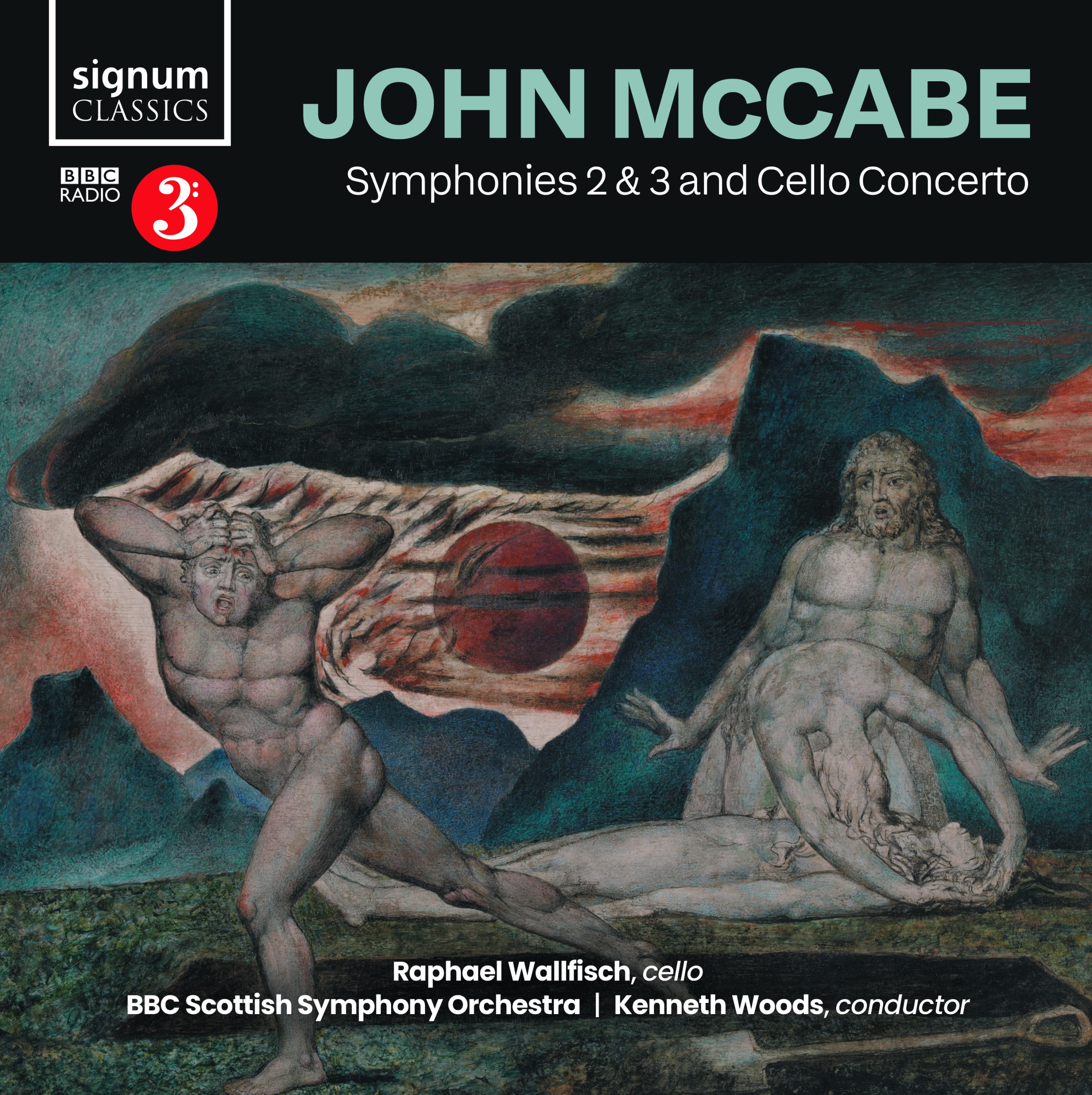
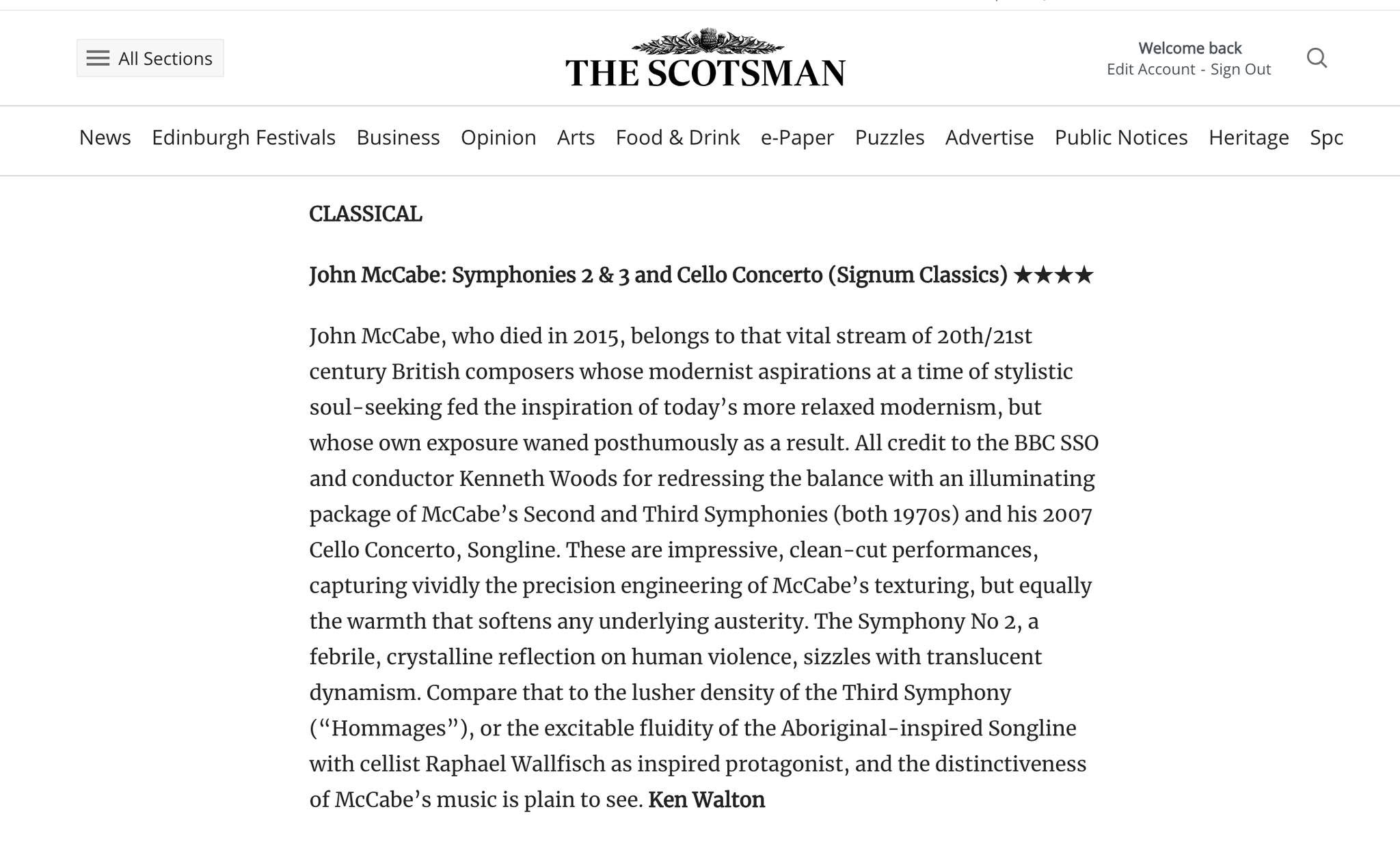
John McCabe: Symphonies 2 & 3 and Cello Concerto (Signum Classics) ????
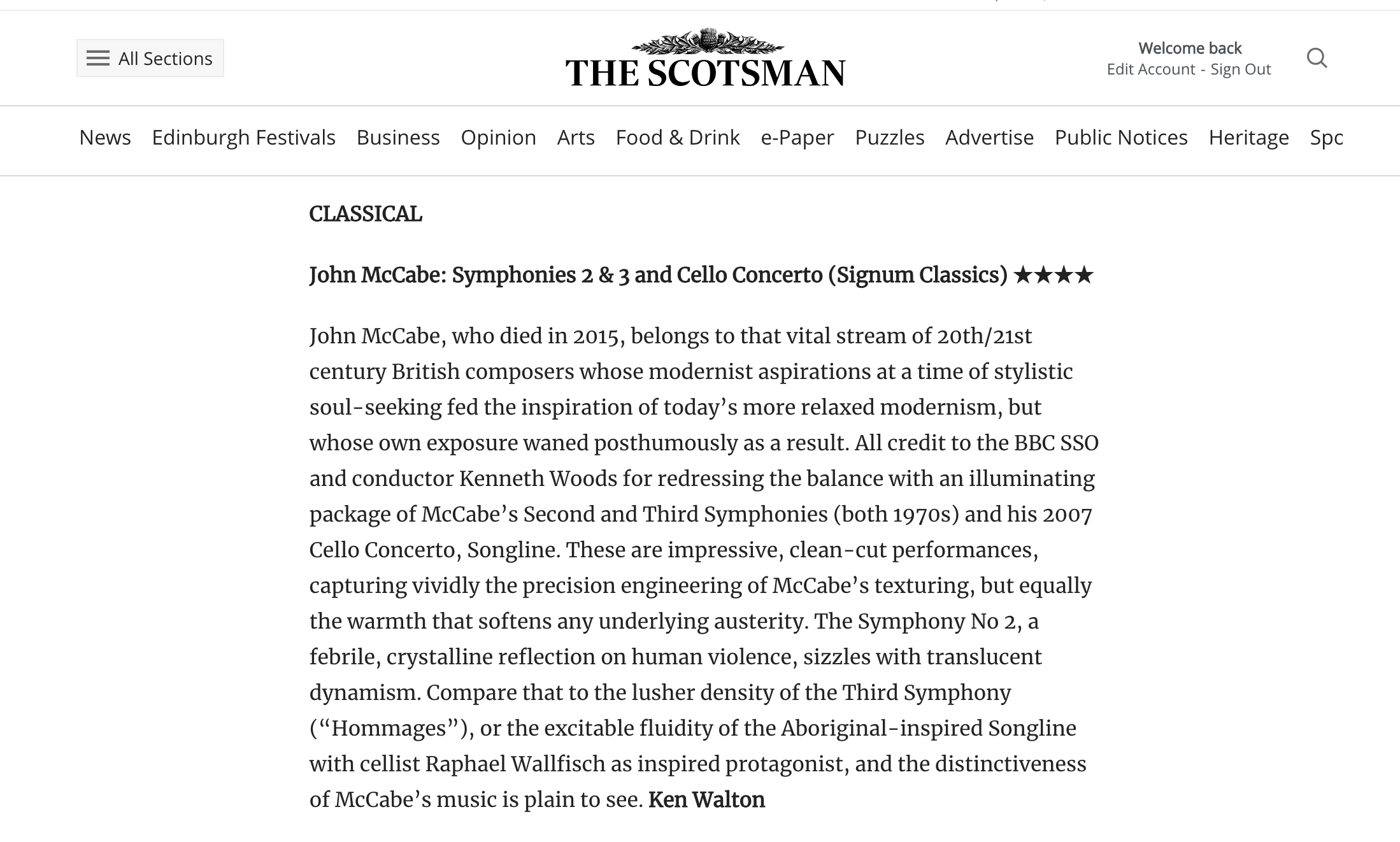
John McCabe, who died in 2015, belongs to that vital stream of 20th/21st century British composers whose modernist aspirations at a time of stylistic soul-seeking fed the inspiration of today’s more relaxed modernism, but whose own exposure waned posthumously as a result. All credit to the BBC SSO and conductor Kenneth Woods for redressing the balance with an illuminating package of McCabe’s Second and Third Symphonies (both 1970s) and his 2007 Cello Concerto, Songline. These are impressive, clean-cut performances, capturing vividly the precision engineering of McCabe’s texturing, but equally the warmth that softens any underlying austerity. The Symphony No 2, a febrile, crystalline reflection on human violence, sizzles with translucent dynamism. Compare that to the lusher density of the Third Symphony (“Hommages”), or the excitable fluidity of the Aboriginal-inspired Songline with cellist Raphael Wallfisch as inspired protagonist, and the distinctiveness of McCabe’s music is plain to see. Ken Walton
RELEASED TODAY, Friday July 24: Signum Classics/John McCabe’s Symphonies Two & Three and Cello Concerto ‘Songline’ – Kenneth Woods/BBC Scottish SO with Raphael Wallfisch.
Jul 24, 2026 | Outstanding [category w.e.f. January 2021], Recording Reviews | 0 comments
Originally posted on June 9
John McCabe’s music has the knack of holding the listener’s attention from the off and keeping it for the duration of the piece, which is certainly true of the three substantial works here, each playing continuously for roughly twenty-five minutes. McCabe (1939-2015), a prolific composer across various genres and ensembles, was also a notable pianist (a pioneer when recording Haydn Sonatas complete for Decca) and gifted with the written word.
The five-movement Second Symphony (1971) owes to The Wild Bunch, Sam Peckinpah’s late-1960s film with a cast including William Holden, Ernest Borgnine and Robert Ryan, the director’s structuring of the movie suggesting to McCabe how his Symphony should progress. With brilliant large-orchestra scoring, a heady atmosphere is created – cinematic indeed – powerful musical arguments making for a tense if compelling journey; potentially a familiar one given Louis Frémaux’s well-established CBSO recording for EMI/Warner that was tied to the premiere.
The remaining pieces are recorded for the first time.
Symphony No.3 (‘Hommages’; 1978), commissioned by the Royal Philharmonic Orchestra, the premiere conducted by Charles Dutoit, is underscored by Haydn and Nielsen, both important to McCabe. It’s eminently listenable, beguiling in its colours and interactions. Early into the final (third) movement a layering of conflicting frequencies reminds of Birtwistle, and from there a huge climax is built, surprising given what has gone before – impassioned, a mighty vehement force unleashed, the polar opposite to the mild-mannered, quietly spoken, totally approachable man that McCabe was on the few occasions our paths crossed at concerts.
The Cello Concerto ‘Songline’ (2007) – a Hallé commission for Truls Mørk, Mark Elder conducted the first performance – is a wonderful opus, neoclassical, lyrical and intimate, attractively quirky in design, ideas and instrumentation. McCabe writes: “The Songlines are the invisible pathways of the Australian aboriginals, routes that they sing into life, naming or relating to everything they see or encounter. These are both physical ways that they walk, during which process every feature of the landscape also has some tribal or mythical significance, and also psychological routes by which they trace their culture.” In passing, a brass flourish might remind of Tippett, a couple of bars could suggest Stravinsky’s Agon. With Raphael Wallfisch in eloquent and quicksilver form, as the music demands, ‘Songline’ invites further listens and the wide appreciation this release affords.
With vibrant and committed performances conducted insightfully by Kenneth Woods that exude rightness throughout, Andrew Keener’s high-end production values, Oscar Torres’s superb sound, and Guy Rickards’s booklet note, this winner of a release is on Signum Classics SIGCD1007 and available from July 24.
Might I suggest to Signum a coupling of McCabe’s Violin Concerto No.2 – a masterpiece (is any soloist playing it following Erich Gruenberg and Dennis Simons?) – with The Chagall Windows (previously Loughran and Haitink).
JOHN McCABE: Orchestral works
Jun 25, 2026 | CD reviews
John McCabe – Orchestral works
Raphael Wallfisch cello
BBC Scottish Symphony Orchestra
Kenneth Woods conductor
SIGNUM SIGCD1007
This is a major release. McCabe’s cello concerto, a work of extraordinary construction and beauty, is one of his most important and compelling works. Premiered by Truls Mørk in 2007, its recording by the equally accomplished Wallfisch is long overdue. The subtitle indicates its indebtedness to Bruce Chatwin’s philosophical novel, The Songlines (1981).
In the long Adagio of the second movement, the soloist traces the physical and psychological pathways of Australian Aboriginal creationist myths, encountering small instrumental combinations that reflect the totemic beings who sang the world into existence.
This profound culture is rich soil for a composer – Britten’s proposed collaboration with Sidney Nolan on a ballet based on the ‘Dreamtimes’ never materialised, alas – but did McCabe know Michael Finnissy’s Red Earth, Peter Sculthorpe’s lyrical Cello Dreaming, or Alan Garner’s superb novel, Strandloper?
One might consider that there is something of the roughness of Finnissy’s scorched landscape, and even a few brief nods to Sculthorpe’s trademark bird-like descending glissandos here (listen, for example, halfway through the second movement after the cello’s mesmeric dialogue with a solo vibraphone).
McCabe’s large orchestra is deployed in variegated chamber-like ensembles whose timbres are very carefully calculated (there is also a prominent part for xylophone), allowing his consistently fresh and intriguing landscape to unfold with a sense of wonder and delight.
The two symphonies have equally intriguing undertones. The main impulse of No. 2 was suggested by Sam Peckinpah’s 1969 film The Wild Bunch – not, the composer was anxious to emphasise, its synopsis, action or inherent violence – but the overall shape of the drama, which McCabe considered to possess a distinctly satisfying sonata-like arch. The five movements follow each other without a break.
Once again, the instrumentation is large, including oboe d’amore, piano, celesta and a large percussion assembly. It is a captivating score, lively and poignant by turns, and is given an authoritative reading. The homages of Symphony no. 3 are not immediately evident, but the slow movement from Haydn’s String Quartet op. 76, no. 6 underpins the Adagio, and two chords from Nielsen’s Suite for Piano are important structural components throughout. Tippett’s The Midsummer Marriage is also not far from this sound-world, particularly in the writing for percussion, and the breathtaking sunburst that concludes this gripping work.
The BBC SSO play with huge commitment under Kenneth Woods, the recording is exceptionally clear, and all instrumental spotlighting has been achieved subtly and naturally. McCabe has been finely served, and it is to be hoped that another issue is on the way.
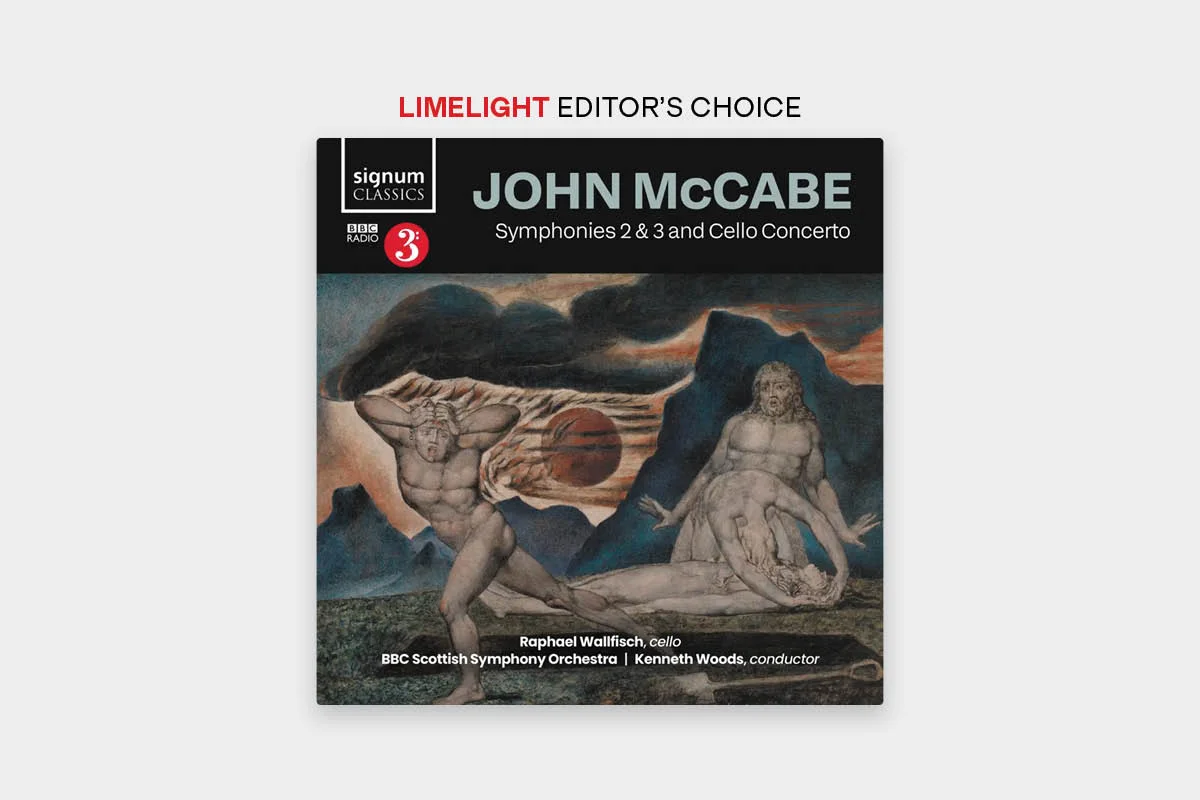
John McCabe: Symphonies 2 & 3 and Cello Concerto (Raphael Wallfisch, BBC Scottish Symphony Orchestra, Kenneth Woods)
A welcome return for a departed English symphonist.
Editor’s Choice – October 2026
by Phillip Scott on 5 September, 2026
EmailFacebookLinkedInXShare
John McCabe (1939–2013) maintained a considerable presence on the British music scene as a composer, pianist, and writer on music, but since his death his own music has had few recordings. It is therefore a pleasure to welcome the arrival of this new release of his previously unrecorded Cello Concerto and Third Symphony. An earlier recording of his Symphony No. 2, made in 1973 with the City of Birmingham SO under Louis Frémaux, was long unavailable. \
According to the composer, his Second Symphony was inspired by Sam Peckinpaw’s 1969 Western, The Wild Bunch, but the music is not as graphic as the movie. Any violence in McCabe’s symphony is nascent, with skittering woodwinds and ominous brass chords providing a constant ‘on the edge’ sensation. (Even more so in Frémaux’s tense performance.) Over the symphony’s Bartókian five-movement arc, jittery nervous passages alternate with quiet brooding, which is how the piece ends. McCabe’s colourful orchestral palette is a notable feature.
That also applies to the ruminative Cello Concerto of 2007. Listen to the delicate use of the vibraphone in the central Adagio. This 25-minute concerto, subtitled “Songlines”, represents a life’s reminiscence with the cello as protagonist. Its continuous three-movement form is episodic, but themes and motifs consistently evolve. The resplendent coda of the finale is a genuine summing up, after which the solo cello line ascends to the heights for a final reflective moment before it is abruptly cut off for good: A dramatic ending to a work full of exquisite ideas.
I have been a fan of McCabe’s music ever since I first heard his Fourth Symphony, Time and the River. In that work, his ability to develop musical material set something of a template for English symphonic thinking in the 21st century. His similar Symphony No. 3 (1978), in three continuous movements, is subtitled “Hommages”. The homages in question are to McCabe’s two most loved composers, Haydn and Nielsen. (He recorded the complete piano output of both.) He does not indulge in stylistic imitation, but there are factors connecting them. A light touch to the scoring and pacing suggests Haydn, while the important role played by woodwinds brings Nielsen to mind. The first movement approaches a Nielsen-like climax, although it is nowhere near as intense or prolonged. The final movement, marked Fugue and Variations, remains very much a product of McCabe’s symphonic style, devoid of classical pastiche. (The variations are more Nielsen than Haydn, but are McCabe above all.) Like pop songs of the 1950s, the symphony ends with a fade-out – a snare drum figure retreating into oblivion. Performances and recording quality are terrific.
Is there a cello concerto that Raphael Wallfisch has not mastered? He plays here with his customary thoughtfulness and understanding. Conductor Kenneth Woods is always in his element with modern symphonic writing, and the Scottish orchestra is its usual reliable self. Mostly, however, it is John McCabe’s music that endures. Thirteen years after the composer’s death, he still speaks to us as contemporaries.
Rated 5 out of 5
Admin –
Geoff Brown – The Times Best Classical Recordings of the month
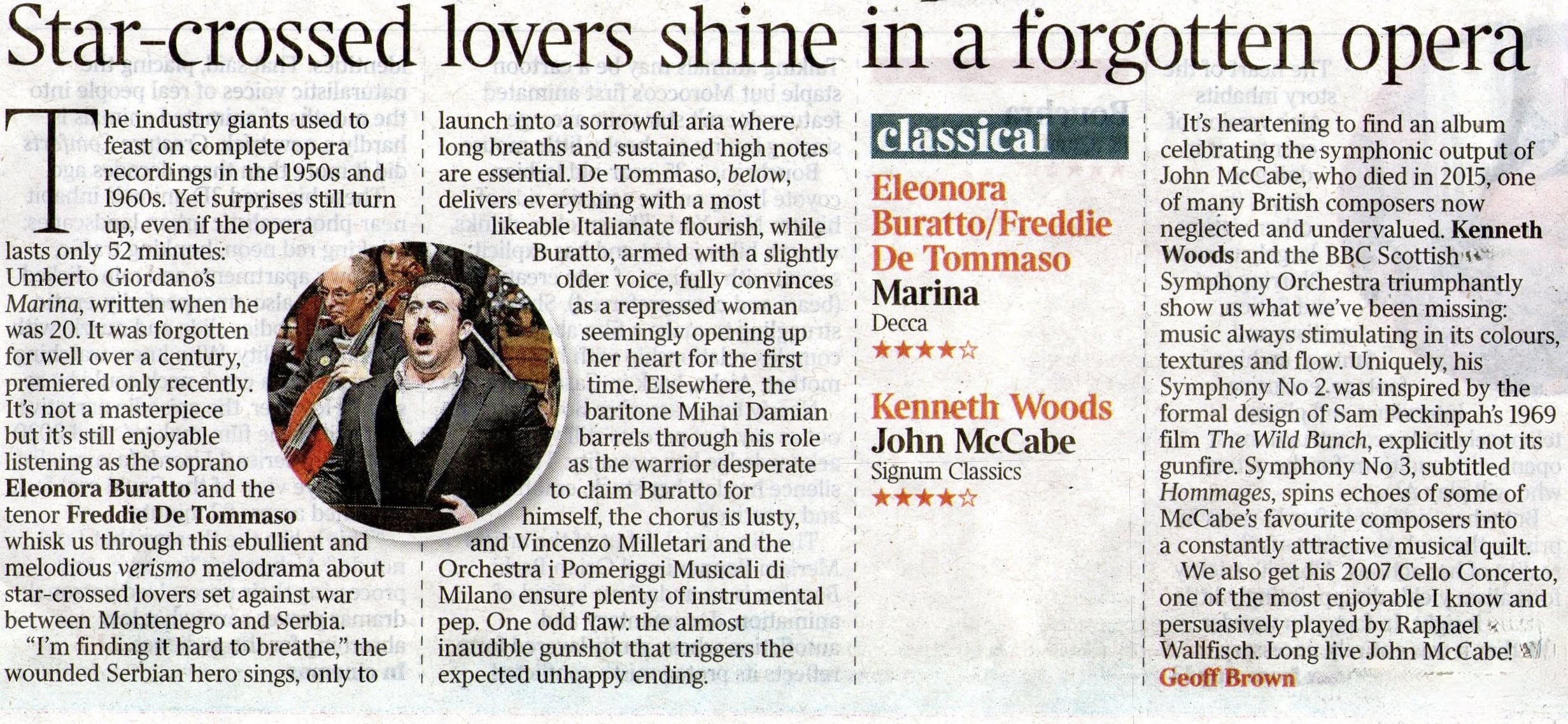
It’s heartening to find an album celebrating the symphonic output of John McCabe, who died in 2015, one of many British composers now neglected and undervalued. Kenneth Woods and the BBC Scottish Symphony Orchestra triumphantly show us what we’ve been missing: music always stimulating in its colours, textures and flow, never locked in an ivory tower or a modernist’s laboratory. Uniquely, his Symphony No 2 was inspired by the formal design of Sam Peckinpah’s 1969 film The Wild Bunch, explicitly not its gunfire. Symphony No 3, subtitled Hommages, spins echoes of some of McCabe’s favourite composers into a constantly attractive musical quilt.
We also get his 2007 Cello Concerto, one of the most enjoyable I know and persuasively played by Raphael Wallfisch — the beneficiary of a dextrous orchestration that never leaves the solo instrument swamped. There’s so much good music here to get to know and enjoy. Long live John McCabe!
John McCabe is beginning to get some fresh interest more than a decade after his death and this recent Signum release [SigCD 1007] is a very nice addition to the growing discography. Raphael Wallfisch is marvelous in the Cello Concerto which is recorded here in a warm, well-blended fashion.
John McCabe – composer and pianist
website
John McCabe – The authoritative internet reference to the music, recordings and writings of the contemporary Eng…
Though not exactly a pastoral panorama, the concerto is something of a relief on the disc, coming after the opening Symphony No. 2, a five-movement meditation on “mankind’s recurring cycles of unthinking and unchanging violence” (Monica McCabe’s description in the accompanying booklet). The symphony’s orchestration and dynamics certainly run the gamut to convey such a subject, and everything is captured well in this recording. The five movements are performed attacca creating an uninterrupted experience that is intense but not unrelenting.
The concluding Symphony No. 3 (“Hommages”) is colorful and thoroughly enjoyable with all movements again played attacca. The “Hommages” are allusions to two of McCabe’s favorite composers: Haydn and Nielsen (not bad choices there). All the pieces on this disc are worth revisiting, and I plan to do so soon.
Speaking of homages, McCabe wrote a Concerto for Orchestra which is something of an homage to Bartók’s in its number of movements and their markings. Perhaps the BBC Scottish Symphony Orchestra and Kenneth Woods will think it worthwhile to record that one, too.
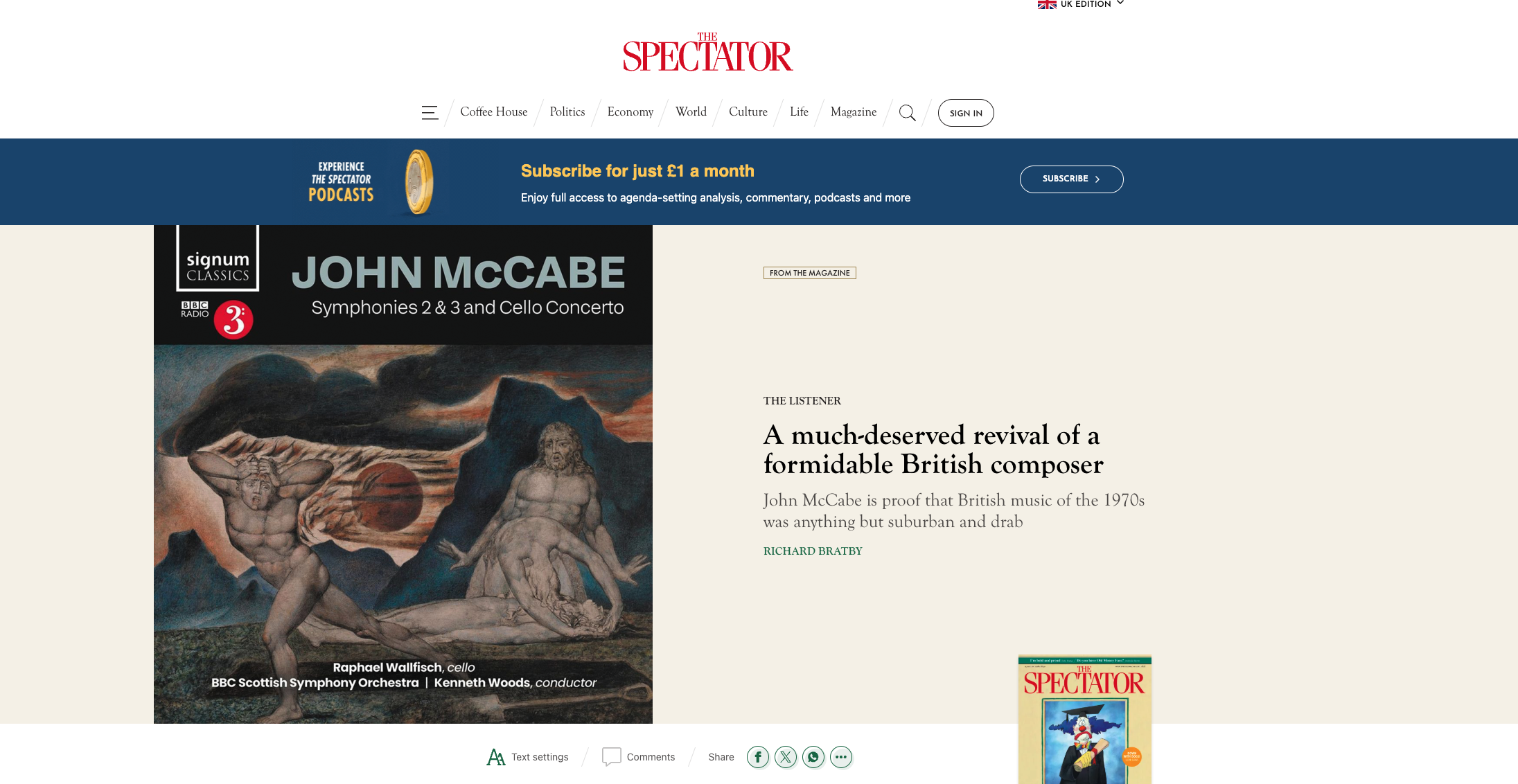
Cheltenham Symphonies’, they used to call them – a catch-all term for the kind of large-scale, traditionally inclined postwar works that found a natural home at the Cheltenham Music Festival. But it was also a sneer: a dig at the supposedly parochial nature of British music in the 1960s and 1970s. Over in Europe, the avant-garde was doing whizzy things with Marxism and electronics. British music, went the narrative, was suburban, outdated and drab.
Now listen to John McCabe’s Third Symphony of 1978. McCabe’s orchestration is as gorgeous as a bird of paradise; it shimmers like the colours on the surface of a bubble. Not that there’s anything fragile about McCabe’s musical engineering. McCabe, a Liverpudlian who died in 2015, was a formidably intelligent pianist (his Haydn recordings are still unrivalled) and in fact the Third Symphony takes its inspiration from Haydn, plus another of McCabe’s symphonic heroes, Carl Nielsen.
You’d never guess it. McCabe’s imagination – here, and in the bigger, more austere Second Symphony of 1971 – has a force that stands unaided, and which carries over into his late cello concerto Songlines, eloquently played by Raphael Wallfisch. Don’t be fooled by the hippy-dippy title; it’s closer to Shostakovich than world music.
All three works are driven with fiery conviction by American conductor Kenneth Woods who has spent much of the last decade reviving and recording Britain’s neglected symphonic heritage. Some day we’ll thank him. Meanwhile, the BBC Scottish Symphony Orchestra struts like a peacock – and why wouldn’t they, when Woods and McCabe make them sound this good?
John McCabe: Symphonies 2 & 3 and Cello Concerto (Signum Classics) ????
John McCabe, who died in 2015, belongs to that vital stream of 20th/21st century British composers whose modernist aspirations at a time of stylistic soul-seeking fed the inspiration of today’s more relaxed modernism, but whose own exposure waned posthumously as a result. All credit to the BBC SSO and conductor Kenneth Woods for redressing the balance with an illuminating package of McCabe’s Second and Third Symphonies (both 1970s) and his 2007 Cello Concerto, Songline. These are impressive, clean-cut performances, capturing vividly the precision engineering of McCabe’s texturing, but equally the warmth that softens any underlying austerity. The Symphony No 2, a febrile, crystalline reflection on human violence, sizzles with translucent dynamism. Compare that to the lusher density of the Third Symphony (“Hommages”), or the excitable fluidity of the Aboriginal-inspired Songline with cellist Raphael Wallfisch as inspired protagonist, and the distinctiveness of McCabe’s music is plain to see. Ken Walton
Rated 5 out of 5
Admin –
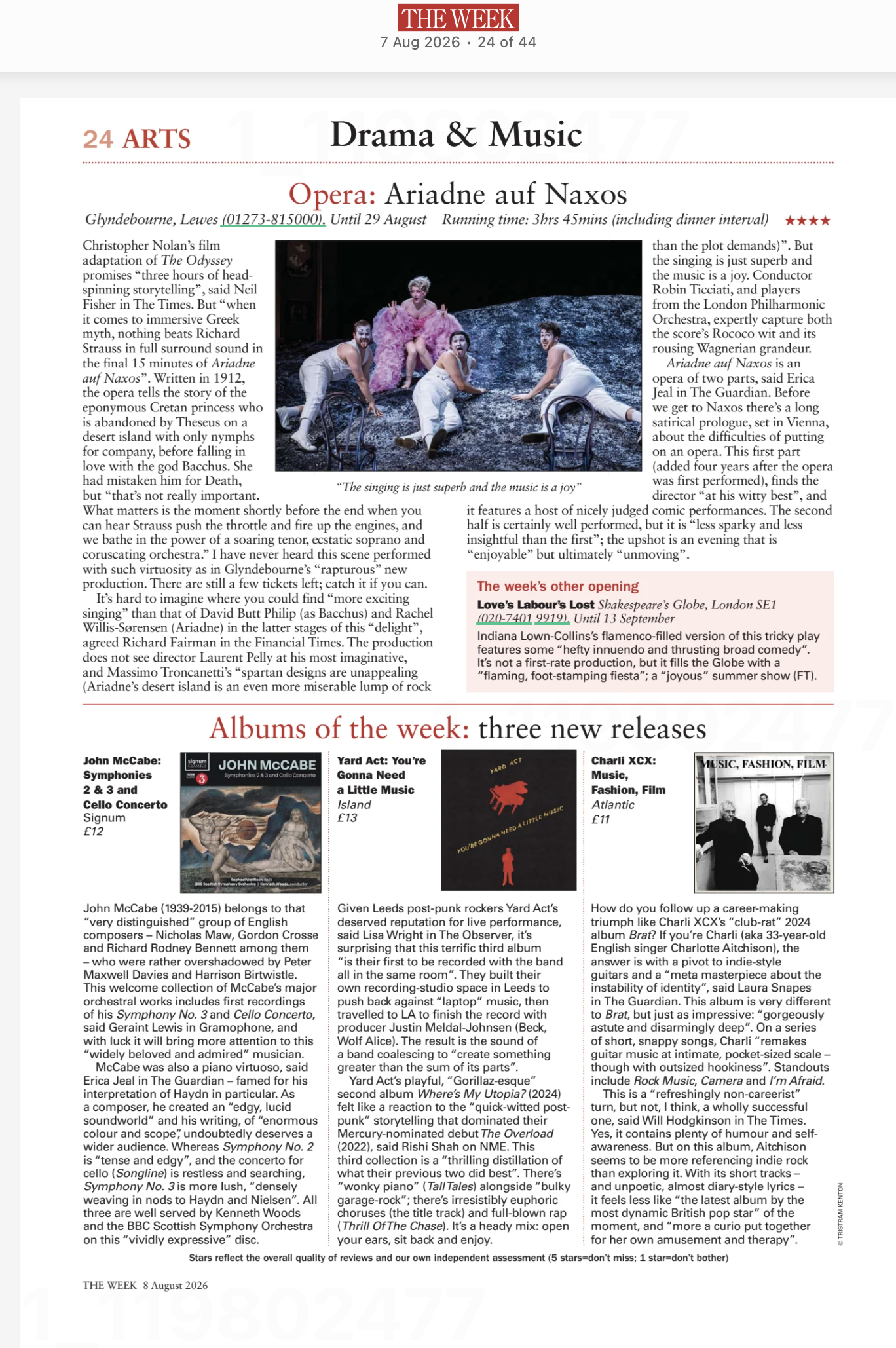
From The Week – Best New Albums of the Week
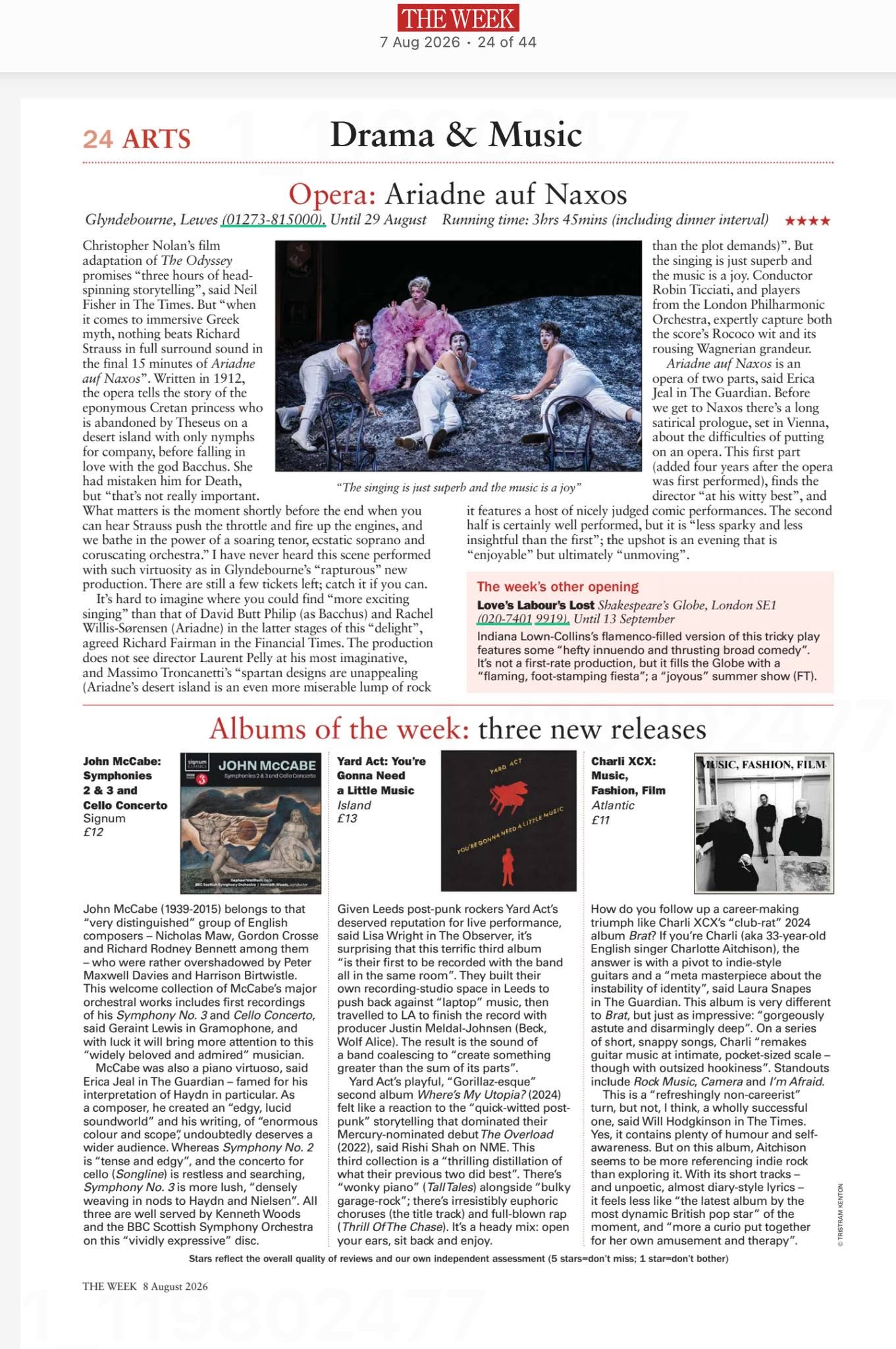
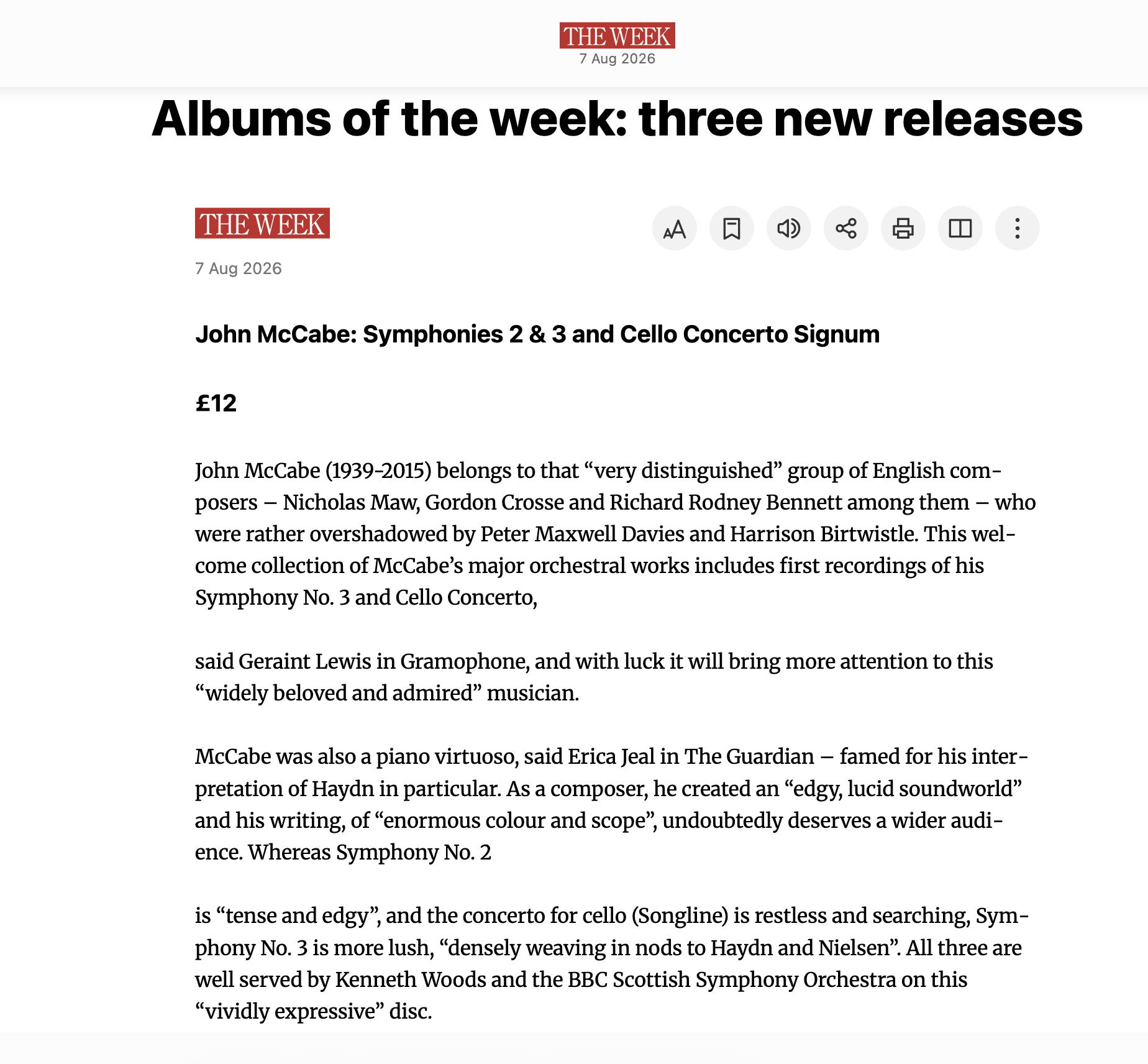
John McCabe: Symphonies 2 & 3 and Cello Concerto Signum
£12
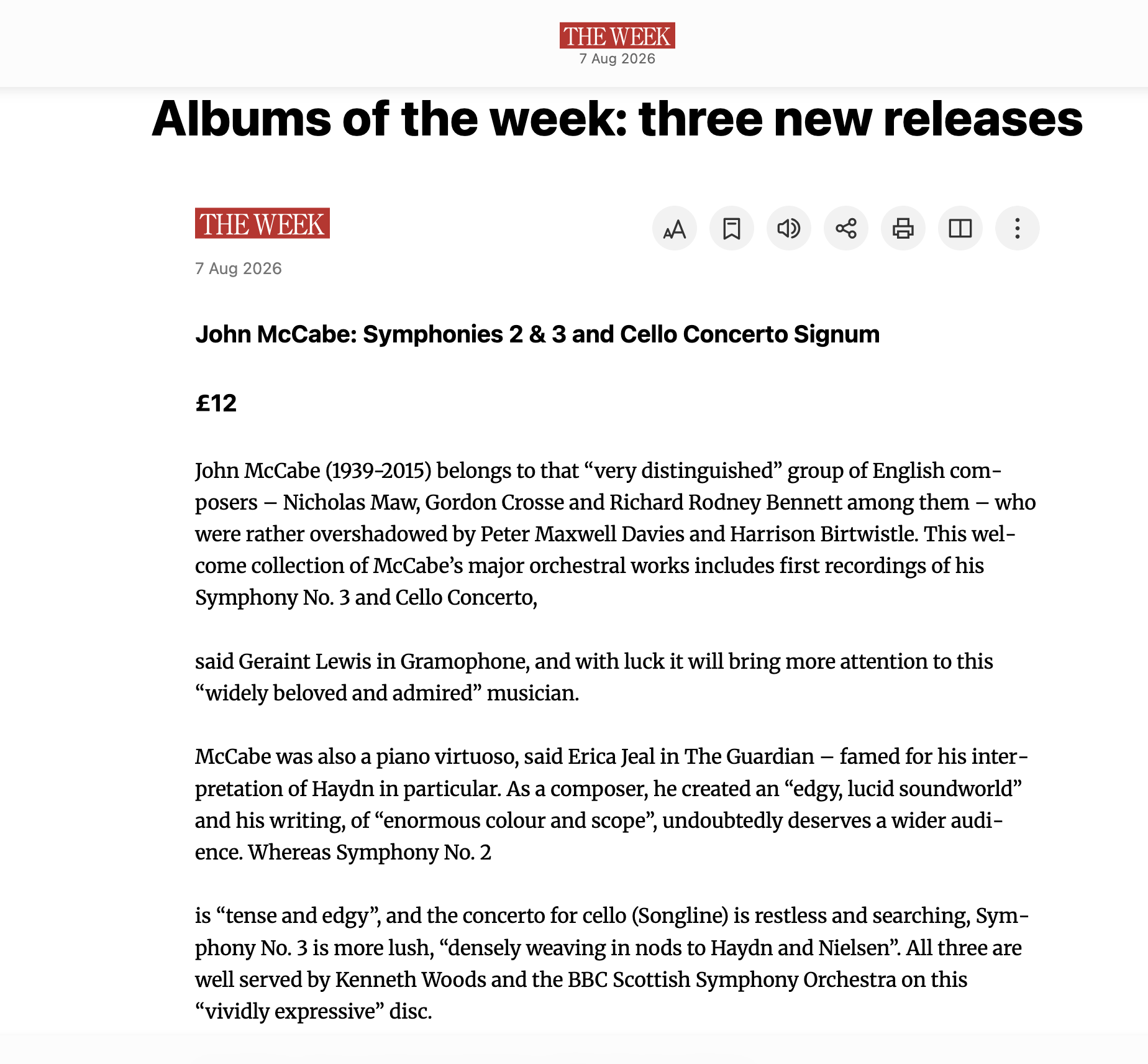
John McCabe (1939-2015) belongs to that “very distinguished” group of English composers – Nicholas Maw, Gordon Crosse and Richard Rodney Bennett among them – who were rather overshadowed by Peter Maxwell Davies and Harrison Birtwistle. This welcome collection of McCabe’s major orchestral works includes first recordings of his Symphony No. 3 and Cello Concerto,
said Geraint Lewis in Gramophone, and with luck it will bring more attention to this “widely beloved and admired” musician.
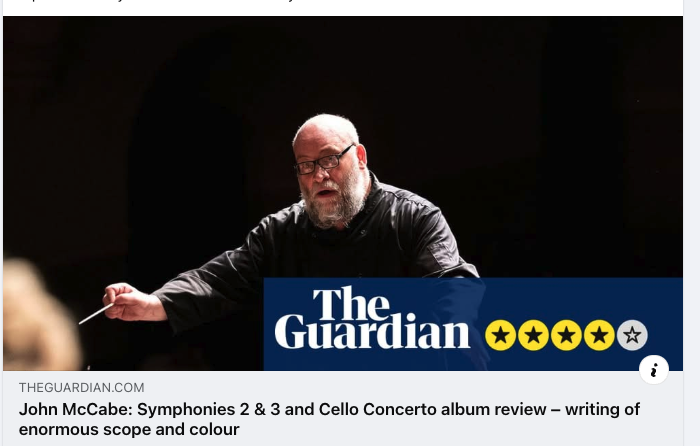
McCabe was also a piano virtuoso, said Erica Jeal in The Guardian – famed for his interpretation of Haydn in particular. As a composer, he created an “edgy, lucid soundworld” and his writing, of “enormous colour and scope”, undoubtedly deserves a wider audience. Whereas Symphony No. 2
is “tense and edgy”, and the concerto for cello (Songline) is restless and searching, Symphony No. 3 is more lush, “densely weaving in nods to Haydn and Nielsen”. All three are well served by Kenneth Woods and the BBC Scottish Symphony Orchestra on this “vividly expressive” disc.
Rated 5 out of 5
Admin –
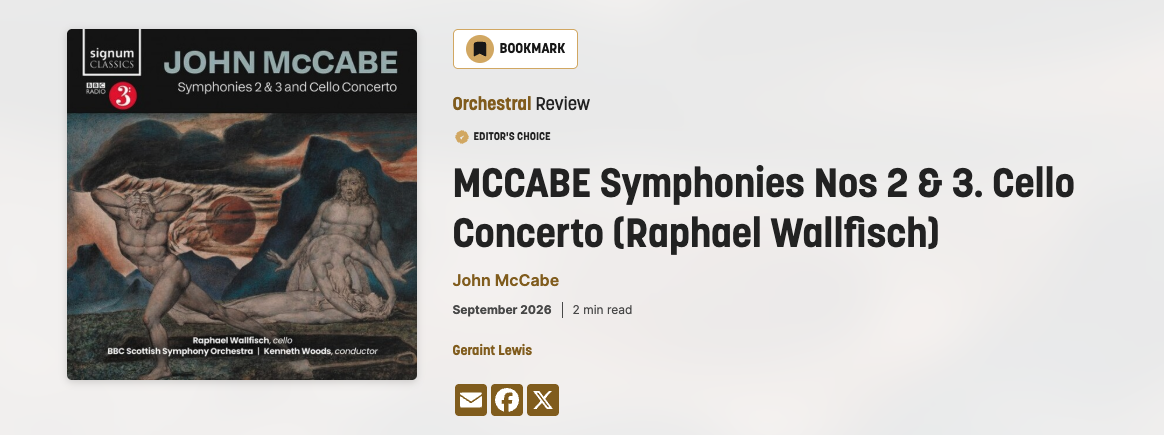
Gramophone Magazine Editor’s Choice
https://www.gramophone.co.uk/reviews/mccabe-symphonies-nos-2-and-3-cello-concerto-raphael-wallfisch
John McCabe died in 2015 and here is a very welcome album of major orchestral works including first recordings of the Third Symphony and the Cello Concerto. Born in 1939, McCabe belonged to a very distinguished clutch of English composers – Nicholas Maw, Richard Rodney Bennett and Gordon Crosse among them – who emerged immediately after the more initially provocative Maxwell Davies and Harrison Birtwistle, both born in 1934. They collectively achieved early prominence in the 1960s, but all now suffer the kind of public neglect that is traditionally the lot of most British composers in the decades immediately following death. McCabe was widely beloved and admired by colleagues and audiences alike during his lifetime and this timely new collection will hopefully draw attention again to his sterling qualities as a composer.The earliest work here is the Second Symphony of 1971, which enjoyed initial fame when recorded for EMI soon after its premiere by the CBSO and Louis Frémaux, coupled with the previous year’s Notturni ed Alba sung by Jill Gomez (11/73). With this landmark collection currently unavailable it is good to welcome a magnificent new recording by the BBC Scottish under Kenneth Woods to refresh the memory of a standout score. It bristles with kinetic energy and its cumulative symphonic structure is impressively built and sustained through a single five-section arch. This patterning was inspired by the 1969 film The Wild Bunch by Sam Peckinpah, a link entirely lost on me – but that is partly the point. As McCabe said himself, it was essentially the film’s shape and not its content (a violent Western) which fed into the music and so the success of that eating-up of external inspiration into abstract expression is proved by its cogent internal argument and the effective evolution of its material. Ignorance of the source – at this distance – is more than likely now a blessing.The Third Symphony’s title, Hommages, refers directly to the inspiration of Haydn and Nielsen – two composers central to McCabe’s musical thinking and piano-playing – as also to the more general sense of paying homage to role models and mentors. Written in 1978 for the RPO and Charles Dutoit, this seems to me an even more exciting work than its predecessor and its first recording thus long overdue. The writing feels freer and the structure flows naturally as a fast-slow-fast arch which finally grows inexorably into an overpowering Nielsen-like climax that immediately fades magically with a Haydnesque surprise. A similar trajectory informs the much later Cello Concerto, commissioned by the Hallé for Truls Mørk and Mark Elder in 2007. Raphael Wallfisch is the passionate soloist here – but again it seems perverse to have waited two decades for such a compelling score to be recorded. The narrative is inspired by ‘the invisible pathways of the Australian Aboriginals, routes that they sing into life’ and which the cellist traces eloquently through a vivid landscape, often evoking the natural world and suggested by the title, Songline. No praise can be too high for these splendid performances, detailed notes by our own Guy Rickards and top-notch production by Andrew Keener. A winner!
Is anyone writing symphonies these days? Not long ago, a symphonic premiere was a highlight of the concert season. That habit died in the present century as orchestras lost confidence in abstract music and composers turned to gimmickry. In the process, a cultural cornerstone has been left to crumble and die.
If the name John McCabe still resonates, it may be for his Decca recordings of the complete piano music of Joseph Haydn, father of the four-movement symphony. Raised on Merseyside by Irish and German-Finn parents, McCabe was drawn to Carl Nielsen and Karl Amadeus Hartmann as primary influences. His orchestral music was regularly performed up to his death in 2015, seldom since.
It is wonderfully refreshing to hear his second and third symphonies again. Both offer structural assurance from the opening statement, one a solo flute, the other a full-ensemble theme. You know where you’re going with McCabe and you sense that the musicians are enjoying the journey every bit as much as you are. The music tells a story and there’s enough going on to sustain concentration. I am reminded of other lost-property symphonists — Alan Rawsthorne, Edmund Rubbra, Malcolm Arnold, Peter Maxwell Davies. All male, none diverse. Don’t expect to hear them any time soon.
The BBC Scottish Symphony Orchestra, conducted by Kenneth Woods, give full expressive value to McCabe’s civilised painterly scores, full of dips and dashes that you’ll want to revisit. Raphael Wallfisch is a mite introspective in the pastel cello concerto but his restraint matches the composer’s undulating understatement. This is such good music I cannot imagine it will be forgotten. The literary novel is making a vigorous comeback from its long-proclaimed death. The modern symphony is overdue a comparable comeback



Admin –
Classical Music Daily
https://www.classicalmusicdaily.com/2026/07/john-mccabe.htm
A Recording to Savour
GEOFF PEARCE admires the music of British composer John McCabe
‘… a fine account of these works …’
I have long been a devotee of John McCabe, both as a pianist and also as a composer, so when I saw this recording, I really wanted to review it, and I am pleased that I did. The album comprises two fine symphonies and the Cello Concerto.
The second symphony, written in 1970-71, is a reflection on the violence that mankind appears to repeat again and again, apparently without thought or reason, and owes much to the Sam Peckinpah movie of 1969, The Wild Bunch, even though the music does not act as a direct impression of any particular scene. It is in five sections of between three to six minutes duration each, and in themselves, they can not be regarded as movements, but, rather, changes of emotion.
The first section, ‘Vivo’, is a kind of nervous and unsettled section which builds in excitement and has considerable tension. The composer is a fine orchestrator and also has a way of managing the progression of a piece in such a way that it is quite logical.
Listen — John McCabe: Vivo (Symphony No 2)
(SIGCD1007 track 1, 3:45-4:26) ? 2025 BBC / Kenneth Woods :
The second section, ‘Andante’, is full of quiet beauty and mystery, at times as if shrouded by mist with shapes emerging and then retreating into the safety of obscurity. There is some beautiful solo work here from the all major sections, particularly flute and oboe d’amore, and the whole of the BBC Scottish Symphony Orchestra responds well to this evocative music under the direction of Kenneth Woods.
Listen — John McCabe: Andante (Symphony No 2)
(SIGCD1007 track 2, 2:22-3:10) ? 2025 BBC / Kenneth Woods :
I particularly enjoyed the third section, which hearkens back to the first, but here there is an airiness and playfulness that is not present at the opening of the work. At the same time there is also drama and darkness, but this is fleeting.
Listen — John McCabe: Allegrissimo (Symphony No 2)
(SIGCD1007 track 3, 2:52-3:33) ? 2025 BBC / Kenneth Woods :
The fourth section is slow, mostly thoughtful and quite sad, although it does become more tense, dense and somewhat dramatic towards the end, before subsiding. Again there is a brief but beautiful oboe d’amore solo towards the final moments.
The last section contains quite a lot of contrasting material and is largely a rather frenetic dance, interspersed with calmer passions and outbursts of violence, ending in sad calmness.
The Cello Concerto, Songline, of 2007 references the Australian Aboriginals and to quote the composer: ‘the invisible pathways of the Australian aboriginals, routes that they sing into life, naming or relating to everything they see or encounter’, which references both physical and psychological paths. McCabe had spent significant time in Australia and the cellist Raphael Wallfisch likewise (and is married to an Australian).
The opening section is full of excitement and is of cheerful disposition, dance-like and playful. There is a sense of wonder, yet also a wry humour. It is an easy and interesting movement to listen to and the cellist has ample opportunities to showcase his technique and also the expressive qualities of his instrument.
Listen — John McCabe: Allegro vivace (Cello Concerto, Songline)
(SIGCD1007 track 6, 3:17-4:11) ? 2025 BBC / Kenneth Woods :
The second movement is the longest and is the core of this concerto, I think. It is resplendent with calls of birds, the quiet chatter of people moving through the landscape and the dappling of light through leaves – at least that is what I imagine. It inhabits a land both familiar and new, and a source of wonder and attachment for one moving through it. There is considerable clarity of texture, reminding me of wide open spaces and clean air. The cello provides the extended narrative around which everything else moves, along with a large central cadenza.
Listen — John McCabe: Adagio (Cello Concerto, Songline)
(SIGCD1007 track 7, 7:32-8:19) ? 2025 BBC / Kenneth Woods :
There are some beautiful moments in this movement and I do hope that it will become a standard in the repertoire, as there is much to recommend here. The last part sets up the following movement and is much more animated.
The final movement is fast and rhythmic, and there is a pulsating drone that reminds me of the liveliness and colour of a corroboree.
Listen — John McCabe: Allegro (Cello Concerto, Songline)
(SIGCD1007 track 8, 2:15-3:15) ? 2025 BBC / Kenneth Woods :
It eventually dissolves into a kind of whisper of a memory and thus ends a very enjoyable concerto, with a sudden clap.
The last work on this disc is the Third Symphony, Hommages, composed in 1978 – a commission from the Royal Philharmonic Orchestra. Here, the composer pays homage to other composers who have meant something to him. He does this on two levels, one by direct quotation, as in the case of Joseph Haydn and Carl Nielsen, and the other by illusion of an aspect of each composer, as in the case of Szymanowski, Schoenberg and Tippett.
The opening movement, ‘Flessible’, uses the slow movement of Haydn’s String Quartet, Op 76 No 6, as the basis of a tune of his own and provides an oscillating two chord pattern drawn from Carl Nielsen’s Suite for Piano, Opus 45. The booklet notes explain how the composer employs this. The result is distinctly John McCabe and does not immediately sound like Haydn or Nielsen. It does not place great demands on the listener, even though it is unmistakably ‘modern’. In my mind, if I am being imaginative, this movement conjured up a nautical feeling, of perhaps sailing on a bright and breezy day, perhaps in a large estuary or lake. It is largely untroubled, but does progress to an impressive climax, yet equally, sometimes the writing is scored as if for a chamber ensemble. There is a strong feeling of direction here, and the music never feels aimless like contemporary music sometimes can.
Listen — John McCabe: Flessible (Symphony No 3, Hommages)
(SIGCD1007 track 9, 4:27-5:18) ? 2025 BBC / Kenneth Woods :
The opening movement leads directly into a central Adagio, also entitled ‘Fantasia’, as does the Haydn slow movement which inspired it. It is build around a roulade in the flutes and is rather otherworldly – actually almost nebulous. I find this quite an unusual movement – more like the wisp of a dream, so that, when one awakens, one knows that one has had a dream, perhaps a vague reminiscence on what it may have been about, but no idea of the content.
Listen — John McCabe: Adagio (Symphony No 3, Hommages)
(SIGCD1007 track 10, 4:28-5:11) ? 2025 BBC / Kenneth Woods :
There is a climax that is a little unsettling towards the end, but then the movement returns to the flutes to calm things down during the second or two before the music moves directly into the final movement.
The final movement, a moderato entitled ‘Fugue-variations’ starts in the piccolo, then one flute, then other instruments are added, and brass and woodwind hasten things along as the pace increases. The music then ebbs and flows a bit, different motifs come and go, sometimes treated in a contrapuntal manner. At places, particularly McCabe’s use of brass and percussion and the wind passages, I am reminded quite a lot of Nielsen, at least in spirit. The climax is glorious, exciting and quite long, in reference to the whole movement, but this subsides into a gentle but satisfying ending.
Listen — John McCabe: Moderato (Symphony No 3, Hommages)
(SIGCD1007 track 11, 8:12-9:09) ? 2025 BBC / Kenneth Woods :
I like John McCabe as a composer, and I think that, outside of the UK, we do not hear enough of his music performed, so this is a very welcome recording of three major works, performed by an orchestra and soloist who provide a fine account of these works, and a conductor who understands the intricacies and direction of this music. I do hope there is greater interest in this quite individual composer of our time. The recorded sound is warm and clear, and the booklet is informative. This is a recording to savour.
Copyright © 14 July 2026 Geoff Pearce, Bomaderry NSW, Australia
Admin –
The Scotsman – Album of the Week
CLASSICAL
John McCabe: Symphonies 2 & 3 and Cello Concerto (Signum Classics) ????
John McCabe, who died in 2015, belongs to that vital stream of 20th/21st century British composers whose modernist aspirations at a time of stylistic soul-seeking fed the inspiration of today’s more relaxed modernism, but whose own exposure waned posthumously as a result. All credit to the BBC SSO and conductor Kenneth Woods for redressing the balance with an illuminating package of McCabe’s Second and Third Symphonies (both 1970s) and his 2007 Cello Concerto, Songline. These are impressive, clean-cut performances, capturing vividly the precision engineering of McCabe’s texturing, but equally the warmth that softens any underlying austerity. The Symphony No 2, a febrile, crystalline reflection on human violence, sizzles with translucent dynamism. Compare that to the lusher density of the Third Symphony (“Hommages”), or the excitable fluidity of the Aboriginal-inspired Songline with cellist Raphael Wallfisch as inspired protagonist, and the distinctiveness of McCabe’s music is plain to see. Ken Walton
Admin –
Colin Anderson – Classical Source
https://www.colinscolumn.com/signum-classics-releases-john-mccabes-symphonies-two-three-and-songline-cello-concerto-kenneth-woods-conducts-bbc-scottish-so-with-raphael-wallfisch/
RELEASED TODAY, Friday July 24: Signum Classics/John McCabe’s Symphonies Two & Three and Cello Concerto ‘Songline’ – Kenneth Woods/BBC Scottish SO with Raphael Wallfisch.
Jul 24, 2026 | Outstanding [category w.e.f. January 2021], Recording Reviews | 0 comments
Originally posted on June 9
John McCabe’s music has the knack of holding the listener’s attention from the off and keeping it for the duration of the piece, which is certainly true of the three substantial works here, each playing continuously for roughly twenty-five minutes. McCabe (1939-2015), a prolific composer across various genres and ensembles, was also a notable pianist (a pioneer when recording Haydn Sonatas complete for Decca) and gifted with the written word.
The five-movement Second Symphony (1971) owes to The Wild Bunch, Sam Peckinpah’s late-1960s film with a cast including William Holden, Ernest Borgnine and Robert Ryan, the director’s structuring of the movie suggesting to McCabe how his Symphony should progress. With brilliant large-orchestra scoring, a heady atmosphere is created – cinematic indeed – powerful musical arguments making for a tense if compelling journey; potentially a familiar one given Louis Frémaux’s well-established CBSO recording for EMI/Warner that was tied to the premiere.
The remaining pieces are recorded for the first time.
Symphony No.3 (‘Hommages’; 1978), commissioned by the Royal Philharmonic Orchestra, the premiere conducted by Charles Dutoit, is underscored by Haydn and Nielsen, both important to McCabe. It’s eminently listenable, beguiling in its colours and interactions. Early into the final (third) movement a layering of conflicting frequencies reminds of Birtwistle, and from there a huge climax is built, surprising given what has gone before – impassioned, a mighty vehement force unleashed, the polar opposite to the mild-mannered, quietly spoken, totally approachable man that McCabe was on the few occasions our paths crossed at concerts.
The Cello Concerto ‘Songline’ (2007) – a Hallé commission for Truls Mørk, Mark Elder conducted the first performance – is a wonderful opus, neoclassical, lyrical and intimate, attractively quirky in design, ideas and instrumentation. McCabe writes: “The Songlines are the invisible pathways of the Australian aboriginals, routes that they sing into life, naming or relating to everything they see or encounter. These are both physical ways that they walk, during which process every feature of the landscape also has some tribal or mythical significance, and also psychological routes by which they trace their culture.” In passing, a brass flourish might remind of Tippett, a couple of bars could suggest Stravinsky’s Agon. With Raphael Wallfisch in eloquent and quicksilver form, as the music demands, ‘Songline’ invites further listens and the wide appreciation this release affords.
With vibrant and committed performances conducted insightfully by Kenneth Woods that exude rightness throughout, Andrew Keener’s high-end production values, Oscar Torres’s superb sound, and Guy Rickards’s booklet note, this winner of a release is on Signum Classics SIGCD1007 and available from July 24.
Might I suggest to Signum a coupling of McCabe’s Violin Concerto No.2 – a masterpiece (is any soloist playing it following Erich Gruenberg and Dennis Simons?) – with The Chagall Windows (previously Loughran and Haitink).
https://signumrecords.com/product/27558/SIGCD1007
Admin –
From British Music Society
https://www.britishmusicsociety.co.uk/2026/06/john-mccabe-orchestral-works/
JOHN McCABE: Orchestral works
Jun 25, 2026 | CD reviews
John McCabe – Orchestral works
Raphael Wallfisch cello
BBC Scottish Symphony Orchestra
Kenneth Woods conductor
SIGNUM SIGCD1007
This is a major release. McCabe’s cello concerto, a work of extraordinary construction and beauty, is one of his most important and compelling works. Premiered by Truls Mørk in 2007, its recording by the equally accomplished Wallfisch is long overdue. The subtitle indicates its indebtedness to Bruce Chatwin’s philosophical novel, The Songlines (1981).
In the long Adagio of the second movement, the soloist traces the physical and psychological pathways of Australian Aboriginal creationist myths, encountering small instrumental combinations that reflect the totemic beings who sang the world into existence.
This profound culture is rich soil for a composer – Britten’s proposed collaboration with Sidney Nolan on a ballet based on the ‘Dreamtimes’ never materialised, alas – but did McCabe know Michael Finnissy’s Red Earth, Peter Sculthorpe’s lyrical Cello Dreaming, or Alan Garner’s superb novel, Strandloper?
One might consider that there is something of the roughness of Finnissy’s scorched landscape, and even a few brief nods to Sculthorpe’s trademark bird-like descending glissandos here (listen, for example, halfway through the second movement after the cello’s mesmeric dialogue with a solo vibraphone).
McCabe’s large orchestra is deployed in variegated chamber-like ensembles whose timbres are very carefully calculated (there is also a prominent part for xylophone), allowing his consistently fresh and intriguing landscape to unfold with a sense of wonder and delight.
The two symphonies have equally intriguing undertones. The main impulse of No. 2 was suggested by Sam Peckinpah’s 1969 film The Wild Bunch – not, the composer was anxious to emphasise, its synopsis, action or inherent violence – but the overall shape of the drama, which McCabe considered to possess a distinctly satisfying sonata-like arch. The five movements follow each other without a break.
Once again, the instrumentation is large, including oboe d’amore, piano, celesta and a large percussion assembly. It is a captivating score, lively and poignant by turns, and is given an authoritative reading. The homages of Symphony no. 3 are not immediately evident, but the slow movement from Haydn’s String Quartet op. 76, no. 6 underpins the Adagio, and two chords from Nielsen’s Suite for Piano are important structural components throughout. Tippett’s The Midsummer Marriage is also not far from this sound-world, particularly in the writing for percussion, and the breathtaking sunburst that concludes this gripping work.
The BBC SSO play with huge commitment under Kenneth Woods, the recording is exceptionally clear, and all instrumental spotlighting has been achieved subtly and naturally. McCabe has been finely served, and it is to be hoped that another issue is on the way.
Review by Andrew Plant
Admin –
Review Limelight Magazine Editor’s Choice
https://limelight-arts.com.au/reviews/john-mccabe-symphonies-2-3-and-cello-concerto-raphael-wallfisch-bbc-scottish-symphony-orchestra-kenneth-woods/
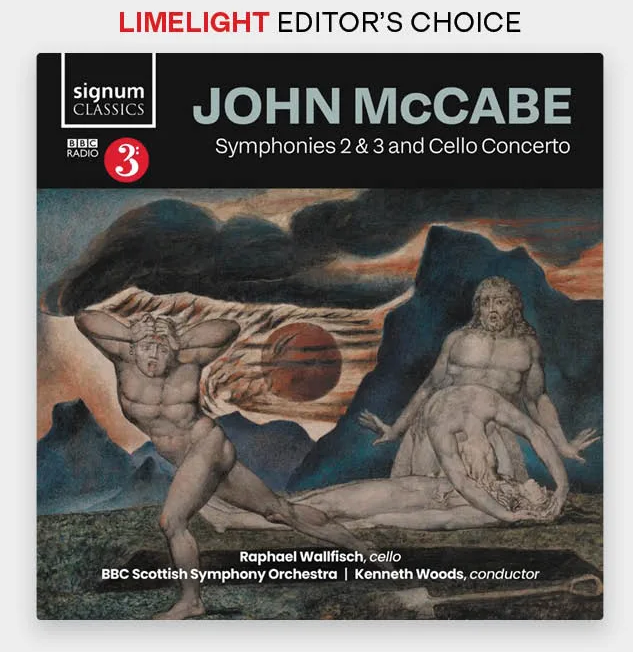
John McCabe: Symphonies 2 & 3 and Cello Concerto (Raphael Wallfisch, BBC Scottish Symphony Orchestra, Kenneth Woods)
A welcome return for a departed English symphonist.
Editor’s Choice – October 2026
by Phillip Scott on 5 September, 2026
EmailFacebookLinkedInXShare
John McCabe (1939–2013) maintained a considerable presence on the British music scene as a composer, pianist, and writer on music, but since his death his own music has had few recordings. It is therefore a pleasure to welcome the arrival of this new release of his previously unrecorded Cello Concerto and Third Symphony. An earlier recording of his Symphony No. 2, made in 1973 with the City of Birmingham SO under Louis Frémaux, was long unavailable. \
According to the composer, his Second Symphony was inspired by Sam Peckinpaw’s 1969 Western, The Wild Bunch, but the music is not as graphic as the movie. Any violence in McCabe’s symphony is nascent, with skittering woodwinds and ominous brass chords providing a constant ‘on the edge’ sensation. (Even more so in Frémaux’s tense performance.) Over the symphony’s Bartókian five-movement arc, jittery nervous passages alternate with quiet brooding, which is how the piece ends. McCabe’s colourful orchestral palette is a notable feature.
That also applies to the ruminative Cello Concerto of 2007. Listen to the delicate use of the vibraphone in the central Adagio. This 25-minute concerto, subtitled “Songlines”, represents a life’s reminiscence with the cello as protagonist. Its continuous three-movement form is episodic, but themes and motifs consistently evolve. The resplendent coda of the finale is a genuine summing up, after which the solo cello line ascends to the heights for a final reflective moment before it is abruptly cut off for good: A dramatic ending to a work full of exquisite ideas.
I have been a fan of McCabe’s music ever since I first heard his Fourth Symphony, Time and the River. In that work, his ability to develop musical material set something of a template for English symphonic thinking in the 21st century. His similar Symphony No. 3 (1978), in three continuous movements, is subtitled “Hommages”. The homages in question are to McCabe’s two most loved composers, Haydn and Nielsen. (He recorded the complete piano output of both.) He does not indulge in stylistic imitation, but there are factors connecting them. A light touch to the scoring and pacing suggests Haydn, while the important role played by woodwinds brings Nielsen to mind. The first movement approaches a Nielsen-like climax, although it is nowhere near as intense or prolonged. The final movement, marked Fugue and Variations, remains very much a product of McCabe’s symphonic style, devoid of classical pastiche. (The variations are more Nielsen than Haydn, but are McCabe above all.) Like pop songs of the 1950s, the symphony ends with a fade-out – a snare drum figure retreating into oblivion. Performances and recording quality are terrific.
Is there a cello concerto that Raphael Wallfisch has not mastered? He plays here with his customary thoughtfulness and understanding. Conductor Kenneth Woods is always in his element with modern symphonic writing, and the Scottish orchestra is its usual reliable self. Mostly, however, it is John McCabe’s music that endures. Thirteen years after the composer’s death, he still speaks to us as contemporaries.
Admin –
Geoff Brown – The Times Best Classical Recordings of the month
https://www.thetimes.com/culture/classical-opera/article/the-best-new-classical-albums-to-listen-to-this-month-0psr8xms8
Kenneth Woods
John McCabe
Signum Classics
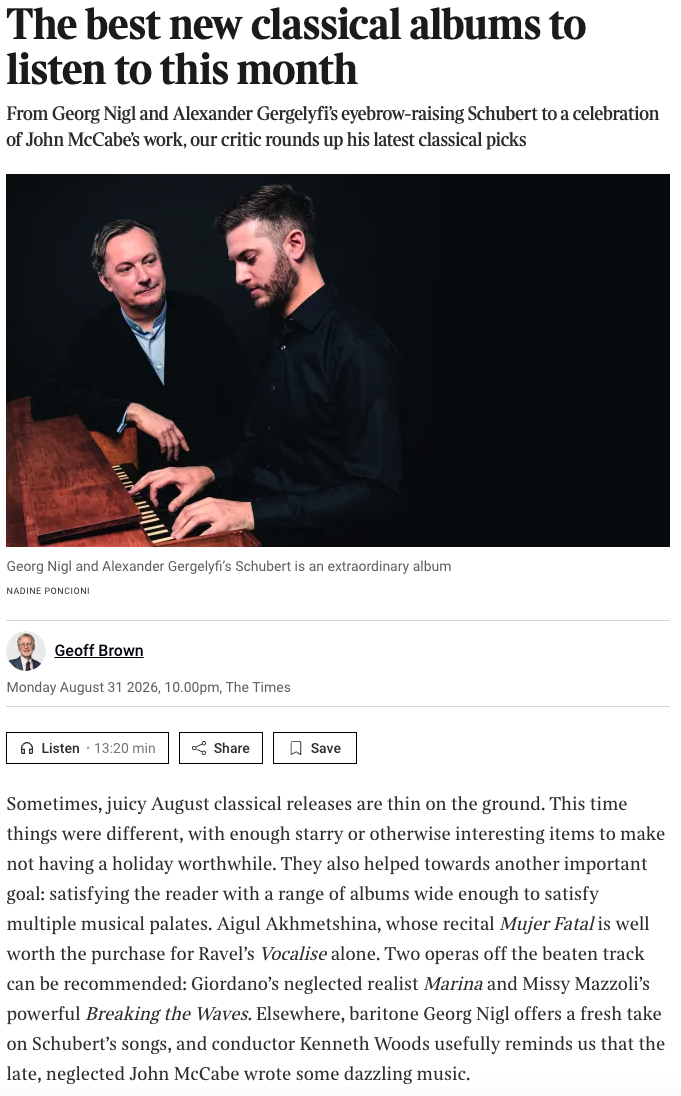
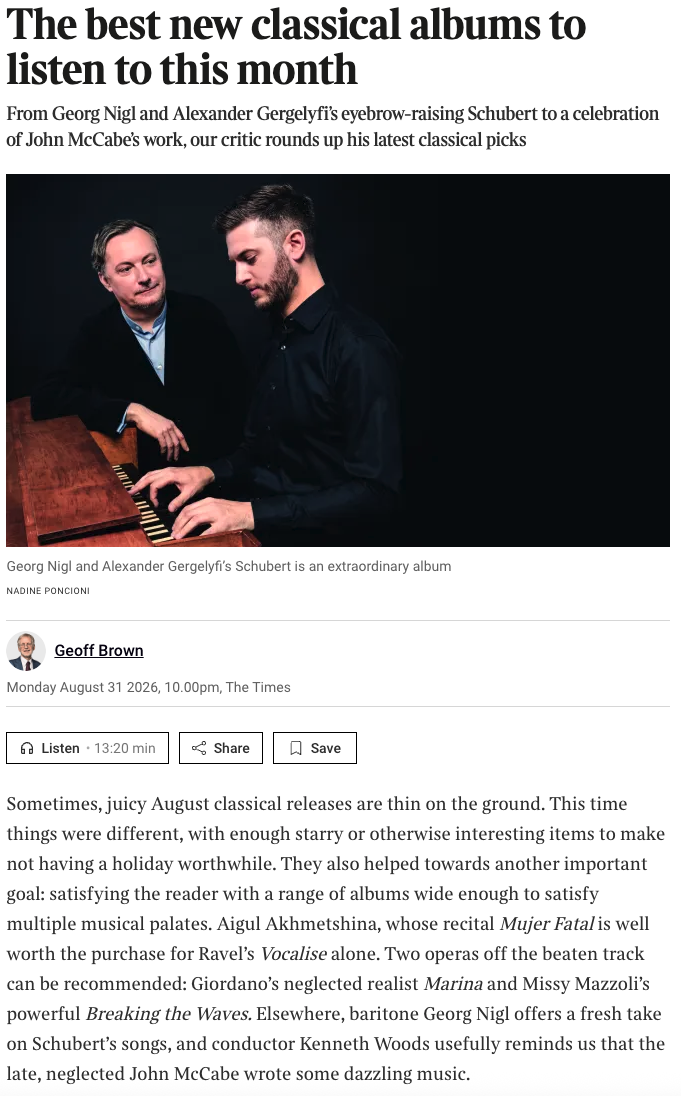
It’s heartening to find an album celebrating the symphonic output of John McCabe, who died in 2015, one of many British composers now neglected and undervalued. Kenneth Woods and the BBC Scottish Symphony Orchestra triumphantly show us what we’ve been missing: music always stimulating in its colours, textures and flow, never locked in an ivory tower or a modernist’s laboratory. Uniquely, his Symphony No 2 was inspired by the formal design of Sam Peckinpah’s 1969 film The Wild Bunch, explicitly not its gunfire. Symphony No 3, subtitled Hommages, spins echoes of some of McCabe’s favourite composers into a constantly attractive musical quilt.
We also get his 2007 Cello Concerto, one of the most enjoyable I know and persuasively played by Raphael Wallfisch — the beneficiary of a dextrous orchestration that never leaves the solo instrument swamped. There’s so much good music here to get to know and enjoy. Long live John McCabe!
Admin –
From WETA FM, Washington
https://weta.org/fm/classical-score/what-our-recording-engineer-listening-summer
John McCabe is beginning to get some fresh interest more than a decade after his death and this recent Signum release [SigCD 1007] is a very nice addition to the growing discography. Raphael Wallfisch is marvelous in the Cello Concerto which is recorded here in a warm, well-blended fashion.
John McCabe – composer and pianist
website
John McCabe – The authoritative internet reference to the music, recordings and writings of the contemporary Eng…
Though not exactly a pastoral panorama, the concerto is something of a relief on the disc, coming after the opening Symphony No. 2, a five-movement meditation on “mankind’s recurring cycles of unthinking and unchanging violence” (Monica McCabe’s description in the accompanying booklet). The symphony’s orchestration and dynamics certainly run the gamut to convey such a subject, and everything is captured well in this recording. The five movements are performed attacca creating an uninterrupted experience that is intense but not unrelenting.
The concluding Symphony No. 3 (“Hommages”) is colorful and thoroughly enjoyable with all movements again played attacca. The “Hommages” are allusions to two of McCabe’s favorite composers: Haydn and Nielsen (not bad choices there). All the pieces on this disc are worth revisiting, and I plan to do so soon.
Speaking of homages, McCabe wrote a Concerto for Orchestra which is something of an homage to Bartók’s in its number of movements and their markings. Perhaps the BBC Scottish Symphony Orchestra and Kenneth Woods will think it worthwhile to record that one, too.
Kenneth Woods –
From Richard Bratby – The Spectator
https://spectator.com/article/a-much-deserved-revival-of-a-formidable-british-composer/
Cheltenham Symphonies’, they used to call them – a catch-all term for the kind of large-scale, traditionally inclined postwar works that found a natural home at the Cheltenham Music Festival. But it was also a sneer: a dig at the supposedly parochial nature of British music in the 1960s and 1970s. Over in Europe, the avant-garde was doing whizzy things with Marxism and electronics. British music, went the narrative, was suburban, outdated and drab.
Now listen to John McCabe’s Third Symphony of 1978. McCabe’s orchestration is as gorgeous as a bird of paradise; it shimmers like the colours on the surface of a bubble. Not that there’s anything fragile about McCabe’s musical engineering. McCabe, a Liverpudlian who died in 2015, was a formidably intelligent pianist (his Haydn recordings are still unrivalled) and in fact the Third Symphony takes its inspiration from Haydn, plus another of McCabe’s symphonic heroes, Carl Nielsen.
You’d never guess it. McCabe’s imagination – here, and in the bigger, more austere Second Symphony of 1971 – has a force that stands unaided, and which carries over into his late cello concerto Songlines, eloquently played by Raphael Wallfisch. Don’t be fooled by the hippy-dippy title; it’s closer to Shostakovich than world music.
All three works are driven with fiery conviction by American conductor Kenneth Woods who has spent much of the last decade reviving and recording Britain’s neglected symphonic heritage. Some day we’ll thank him. Meanwhile, the BBC Scottish Symphony Orchestra struts like a peacock – and why wouldn’t they, when Woods and McCabe make them sound this good?
admin –
From The Scotsman
https://www.scotsman.com/arts-and-culture/music/album-reviews-jungle-the-womack-sisters-the-anchoress-8841851
CLASSICAL
John McCabe: Symphonies 2 & 3 and Cello Concerto (Signum Classics) ????
John McCabe, who died in 2015, belongs to that vital stream of 20th/21st century British composers whose modernist aspirations at a time of stylistic soul-seeking fed the inspiration of today’s more relaxed modernism, but whose own exposure waned posthumously as a result. All credit to the BBC SSO and conductor Kenneth Woods for redressing the balance with an illuminating package of McCabe’s Second and Third Symphonies (both 1970s) and his 2007 Cello Concerto, Songline. These are impressive, clean-cut performances, capturing vividly the precision engineering of McCabe’s texturing, but equally the warmth that softens any underlying austerity. The Symphony No 2, a febrile, crystalline reflection on human violence, sizzles with translucent dynamism. Compare that to the lusher density of the Third Symphony (“Hommages”), or the excitable fluidity of the Aboriginal-inspired Songline with cellist Raphael Wallfisch as inspired protagonist, and the distinctiveness of McCabe’s music is plain to see. Ken Walton
Admin –
From The Week – Best New Albums of the Week
John McCabe: Symphonies 2 & 3 and Cello Concerto Signum
£12
John McCabe (1939-2015) belongs to that “very distinguished” group of English composers – Nicholas Maw, Gordon Crosse and Richard Rodney Bennett among them – who were rather overshadowed by Peter Maxwell Davies and Harrison Birtwistle. This welcome collection of McCabe’s major orchestral works includes first recordings of his Symphony No. 3 and Cello Concerto,
said Geraint Lewis in Gramophone, and with luck it will bring more attention to this “widely beloved and admired” musician.
McCabe was also a piano virtuoso, said Erica Jeal in The Guardian – famed for his interpretation of Haydn in particular. As a composer, he created an “edgy, lucid soundworld” and his writing, of “enormous colour and scope”, undoubtedly deserves a wider audience. Whereas Symphony No. 2
is “tense and edgy”, and the concerto for cello (Songline) is restless and searching, Symphony No. 3 is more lush, “densely weaving in nods to Haydn and Nielsen”. All three are well served by Kenneth Woods and the BBC Scottish Symphony Orchestra on this “vividly expressive” disc.
Admin –
Gramophone Magazine Editor’s Choice
https://www.gramophone.co.uk/reviews/mccabe-symphonies-nos-2-and-3-cello-concerto-raphael-wallfisch
John McCabe died in 2015 and here is a very welcome album of major orchestral works including first recordings of the Third Symphony and the Cello Concerto. Born in 1939, McCabe belonged to a very distinguished clutch of English composers – Nicholas Maw, Richard Rodney Bennett and Gordon Crosse among them – who emerged immediately after the more initially provocative Maxwell Davies and Harrison Birtwistle, both born in 1934. They collectively achieved early prominence in the 1960s, but all now suffer the kind of public neglect that is traditionally the lot of most British composers in the decades immediately following death. McCabe was widely beloved and admired by colleagues and audiences alike during his lifetime and this timely new collection will hopefully draw attention again to his sterling qualities as a composer.The earliest work here is the Second Symphony of 1971, which enjoyed initial fame when recorded for EMI soon after its premiere by the CBSO and Louis Frémaux, coupled with the previous year’s Notturni ed Alba sung by Jill Gomez (11/73). With this landmark collection currently unavailable it is good to welcome a magnificent new recording by the BBC Scottish under Kenneth Woods to refresh the memory of a standout score. It bristles with kinetic energy and its cumulative symphonic structure is impressively built and sustained through a single five-section arch. This patterning was inspired by the 1969 film The Wild Bunch by Sam Peckinpah, a link entirely lost on me – but that is partly the point. As McCabe said himself, it was essentially the film’s shape and not its content (a violent Western) which fed into the music and so the success of that eating-up of external inspiration into abstract expression is proved by its cogent internal argument and the effective evolution of its material. Ignorance of the source – at this distance – is more than likely now a blessing.The Third Symphony’s title, Hommages, refers directly to the inspiration of Haydn and Nielsen – two composers central to McCabe’s musical thinking and piano-playing – as also to the more general sense of paying homage to role models and mentors. Written in 1978 for the RPO and Charles Dutoit, this seems to me an even more exciting work than its predecessor and its first recording thus long overdue. The writing feels freer and the structure flows naturally as a fast-slow-fast arch which finally grows inexorably into an overpowering Nielsen-like climax that immediately fades magically with a Haydnesque surprise. A similar trajectory informs the much later Cello Concerto, commissioned by the Hallé for Truls Mørk and Mark Elder in 2007. Raphael Wallfisch is the passionate soloist here – but again it seems perverse to have waited two decades for such a compelling score to be recorded. The narrative is inspired by ‘the invisible pathways of the Australian Aboriginals, routes that they sing into life’ and which the cellist traces eloquently through a vivid landscape, often evoking the natural world and suggested by the title, Songline. No praise can be too high for these splendid performances, detailed notes by our own Guy Rickards and top-notch production by Andrew Keener. A winner!
Admin –
Lebrecht’s Album of the Week. The Critic Magazine
7 June, 2026
https://thecritic.co.uk/symphonies-have-life/
By
Norman Lebrecht
Share
????
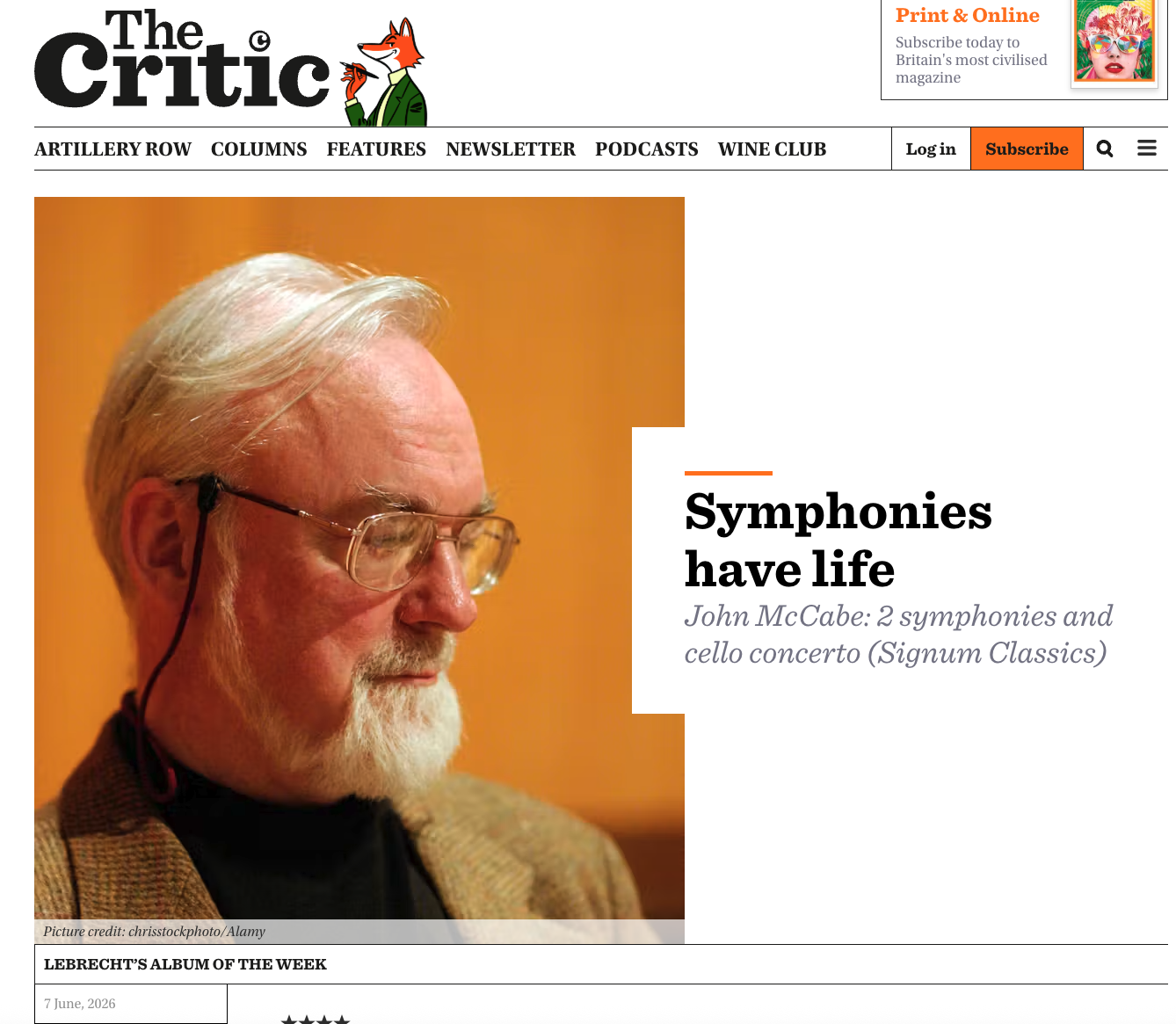
Is anyone writing symphonies these days? Not long ago, a symphonic premiere was a highlight of the concert season. That habit died in the present century as orchestras lost confidence in abstract music and composers turned to gimmickry. In the process, a cultural cornerstone has been left to crumble and die.
If the name John McCabe still resonates, it may be for his Decca recordings of the complete piano music of Joseph Haydn, father of the four-movement symphony. Raised on Merseyside by Irish and German-Finn parents, McCabe was drawn to Carl Nielsen and Karl Amadeus Hartmann as primary influences. His orchestral music was regularly performed up to his death in 2015, seldom since.
It is wonderfully refreshing to hear his second and third symphonies again. Both offer structural assurance from the opening statement, one a solo flute, the other a full-ensemble theme. You know where you’re going with McCabe and you sense that the musicians are enjoying the journey every bit as much as you are. The music tells a story and there’s enough going on to sustain concentration. I am reminded of other lost-property symphonists — Alan Rawsthorne, Edmund Rubbra, Malcolm Arnold, Peter Maxwell Davies. All male, none diverse. Don’t expect to hear them any time soon.
The BBC Scottish Symphony Orchestra, conducted by Kenneth Woods, give full expressive value to McCabe’s civilised painterly scores, full of dips and dashes that you’ll want to revisit. Raphael Wallfisch is a mite introspective in the pastel cello concerto but his restraint matches the composer’s undulating understatement. This is such good music I cannot imagine it will be forgotten. The literary novel is making a vigorous comeback from its long-proclaimed death. The modern symphony is overdue a comparable comeback